雅思备考:写作 (Writing)
雅思备考笔记之写作部分。
Writing
Sport&Health
an unhealthy lifestyle sedentary adj. 久坐的,不活动的 lead a sedentary lifestyle 过一种缺少运动的生活方式 adopt various lifestyles 采用不同的生活方式 be inclined/prone to do 倾向做某事 smoking, drug misuse, and alcohol abuse 吸烟,药物滥用和酗酒 limit/restrict/curtail the freedom of 限制···的自由 a major concern 一个令人担忧的问题 be unaware of 不知道,未意识到 declining level of public health 公众健康水平下降 damaging to (one’s) health 危害健康 suffer from/develop chronic disease 患上慢性疾病 respiratory disease 呼吸系统疾病 diabetes 糖尿病 high-fat 高脂肪的 calorie 卡路里 over nourishment 营养过剩 over-nourished nourishing/nutritious 有营养的 nutrients 营养(物) the increasing availability of convenience foods 日益普及的方便食品 processed foods 经加工的食品 sophisticated 精致的 home-cooked meals 家里的饭菜 an important aspect of culture and social life 文化和社会生活的重要部分 entertainment/diversion/recreation/amusement n. 娱乐,消遣 well-being 康乐、安乐 welfare system 福利系统 promote healthy way of living 推广健康生活方式 promotion of healthy lifestyle enhance public health 提高公众健康 mental well-being 心理健康 improved cardiovascular health 改善的心血管健康 weight management 体重管理 stress reduction 减压 affordable healthcare 可负担的医疗 urban planning that prioritizes active lifestyle 优先考虑积极生活方式的城市规划 accessible sports facilities 无障碍体育设施 expand sports facilities 增加体育设施 engage in regular exercise 经常参加体育锻炼 be accustomed/used to physical activity 习惯于体育活动 provide more access to physical exercise 提供更多的体育锻炼机会 construct public parks and sports facilities 建设公园和体育设施 explore outdoor activities 探索户外活动 impose heavy taxes on unhealthy consumer goods 对不健康的消费品征收重税 promote/advocate/uphold/call for healthy consumption habits 提倡健康的消费习惯 break unhealthy habits 改掉有害健康的习惯 recognize the limitations of the approach 认识到这种方法的局限性 ==reach people who lack health awareness ==触达缺乏健康意识的人 a comprehensive/holistic strategy 一个全面的策略 achieve sustainable and widespread improvements in public well-being 实现公众健康可持续和广泛的改善 be well positioned to 处于有利地位 run more efficient campaigns 开展更有效的活动 addressing the complex factors influencing public health 处理影响公共卫生的复杂因素 the government should play a leading role and work collectively across legislative, regulatory and tax authorities 政府应该发挥领导作用,并在立法、监督和税务部门之间共同努力
The Media
the media n. 媒体,大众传播媒介(不可数名词)the mass media, the news media, the broadcasting media, the print media, the national media, social media=social networking, electronic media, audiovisual media news outlet 新闻媒体 the press 报刊(总称),新闻界 coverage n. 报道(不可数) media coverage, media coverage of …, coverage of news about serious events and issues 对重大事件和问题的新闻报道 cover v. 报道 broadcast v. 播送 broadcast the news deliver news 传递消息,发布消息 release v. 公布 release the news 公布消息 report … in graphic detail 非常详尽的报道 factual accounts 如实的报道(e.g. give a factual account of …) visual element 视觉元素 represent v. 展示,描述 a vivid and impactful representation of 生动且有力的描述 authentic adj. 真实的,可靠的 authenticity n. 真实性,可靠性 immediate adj. 即刻的 immediacy n. 直接性,直观性 context n. 语境 take out of context 断章取义 manipulate v. 篡改 a well-framed photograph 一张装帧精美的照片 a carefully edited video 一段精心编辑的视频 snapshot n. 简洁 a snapshot of a moment frozen in time 展示了一个被冻结在时间里的瞬间 capture the essence of an event 捕捉事件的本质 convey the gravity of a situation 传达情况的严重性 evoke powerful emotions 唤起强烈的情感 foster empathy among the audience 培养观众的同理心 transcend the language barriers 超越语言障碍 make information accessible to a global audience 使全球受众都能获得信息 nuanced adj. 细致入微的 nuance n. 细微差别 v. 使产生细微差别 nuisance n. 麻烦事,讨厌的人 a more nuanced understanding of the story 对故事更细致入微的理解 integrity n. 诚实正直,完整 journalistic integrity 新闻道德 code of conduct 行为准则 code of ethics 道德规范 work ethics 职业道德 newsworthy adj. 有新闻价值的 up-to-date/up-to-the-minute adj. 最新的,及时的 objective and balanced adj. 客观公正的 reliable/trustworthy/dependable adj. 可信的,可靠的 reliability n. 可靠性,可信赖 biased/skewed adj. 不客观的,有偏见的 distorted/misleading/misrepresented adj. 误导的,不如实报道的,曲解的 fraudulent adj. 欺骗性的 distorted storyline(s) 扭曲的故事情节 misinformation n. 误报,错误信息 a skewed narrative 歪曲的叙述 sensational headlines(s) 轰动的标题 compete for attention with 争夺注意力 current affairs 时事 breaking news 爆炸新闻,突发新闻(没有break news) informative adj. 信息量大的 entertaining adj. 娱乐性的 prevalent/pervasive adj. 无所不在的,普遍存在的 the prevalence of … 什么的流行、盛行 vogue n. 流行 adj. 流行的 be flooded (or filled) with … 充斥着 excessive violent and pornographic contents 过多的暴力与色情内容 at the expense/cost of … 以什么为代价 a profound effect on … 对什么有着深远的影响 censor v.&n. 审查 censorship n. 审查制度 impose censorship on … 对什么实施审查 monitor/supervise/oversee v. 监督 delete/eliminate v. 删除 violate someone’s privacy 侵犯某人的隐私 evaluate v. 评价,评估 evaluation on … 对什么的评价、评估 critical adj. 批判的 disclose/expose/reveal/unveil social problems 揭露社会问题 hype n. 炒作,大肆吹捧 v. 对什么大肆宣传,吹捧 media hype 媒体炒作 advertising hype 广告炒作 advertising n. 广告(不可数名词)advertising directed/targeted at children 儿童广告 advertising marketed towards children 儿童广告 advertisement n. 广告(可数) commercial n. 商业广告(可数) public service advertising 公益广告 evoke/stimulate impulse buying 刺激冲动性购物 something has great appeal to someone 某物对某人有很大的吸引力 shopaholic n. 购物狂(可数) promotion n. 推广,促销,晋级,升级 marketing tool 市场营销手段 induce someone to do something 诱导、引诱某人做某事 target audience 目标受众 sensationalize/exaggerate v. 耸人听闻的夸大某事,大肆渲染 over-report … to hook viewers so as to maximize profits 为了利益最大化,从而过度报道什么来吸引公众的眼球 spin out of control 事态发展失控 celebrity n. 名人 cult of celebrity 名人热,名人崇拜 publicity n. 宣传,宣扬,公开 receive publicity 获取公众关注度 notoriety n. 声名狼藉,臭名昭著 notorious adj. 声名狼藉的 paparazzi n. 狗仔队(单复) gossip n. 流言蜚语(可数) v. 讲闲话 scandal n. 丑闻(可数) cover up/gloss over/whitewash v. 掩盖 the poor, the sick, and the disenfranchised 穷人,病人和被剥夺公民权的人 philanthropy n. 慈善 philanthropist n. 慈善家 circulation n. 发行量 circulation of a newspaper 一份报纸的发行量 a unique sensory experience 独特的感官体验 texture of paper 纸的质地 sound of turning pages 翻页的声音 scent of ink 墨香 unique quality 特质 contribute to a multisensory engagement 促进多感官参与 gratifying/satisfying adj. 令人高兴的,使人满意的 foster a deeper connection with the content of the book 培养与书籍内容更深层次的联系 enhance the overall reading experience 提高整体阅读体验 a more relaxed and healthier reading experience 更轻松、更健康的阅读体验 ensure a diverse and enriched reading culture 确保多元化和丰富的阅读文化
Education
primary education, elementary education 小学 secondary education 初中 high school 高中 high school graduate 高中毕业生 general education 通识教育 university student 大学生 college graduates 大学毕业生 higher education 高等教育 vocational diploma 职业证书 adult illiteracy 成年人文盲 approach to education, method of education, fashion of education 教育方法 schooling=school education 学校教育 students are inspired to do something 启发学生做某事 impart knowledge (to someone) 传授知识 obtain/acquire knowledge and skills 获得知识和技能 command/grasp/mastery of something 对什么的掌握、精通 a good command of English motivated adj. 积极的,有动力的 students are motivated to do something initiative n. 倡议,主动性 ==students should be encouraged to take the initiative to do something == reasoning ability 推理能力 analyzing skills and problem-solving ability 分析和解决问题的能力 creative/original 有创造力的 creativity/originality 创造力 creative thinking 创新思维 critical thinking 批判性思维 students should be encouraged to think critically communication and social skills 沟通、社交能力 team spirit 团队精神 youth 青年时期 the youth, teenager, adolescent juvenile 少年的 juvenile crime 少年犯罪 juvenile offender/delinquent 少年犯 aptitude (for), talent (for) n. 天资,禀赋 an all-round/all-around education 全面教育,综合教育 well-rounded development of students 学生的全面发展 versatile 多才多艺的 versatility n. 多才多艺 volatile adj. 易变的,易挥发的 n. 挥发物 develop/cultivate/nurture/foster v. 发展,培养 foster personal development 促进个人发展 promote the development of 促进什么的发展 mould/mold one’s character 塑造性格 shape one’s view of the world 塑造世界观 popular/prevalent values and attitude 普遍存在的价值观、态度 critical time of physical and psychological development 身心发展的关键期 the awareness/sense of 什么的意识 sense of responsibility/duty/obligation 责任感 lack of self-control 缺少自控力 lack self-control discipline 纪律,学科 impressionable adj. 易受影响的 vulnerable groups 弱势群体 be vulnerable to negative influence 易受外界不良影响 be unable to distinguish right from wrong 没有能力判断是非 have less awareness of adverse consequences 无法充分意识到不良后果 take sensible precautions 采取合理的预防措施 misbehavior/misbehaviour = poor behavior n. 品行不端 vile behavior 恶劣的行为 acceptable/appropriate/proper behavior 得当的行为 teaching students how to judge right and wrong and how to behave well 教学生如何判断是非,如何表现良好 the development of students’ personality and values 学生个性和价值观的发展 make contributions to social progress, contribute to the progress of society 对社会进步做贡献 social welfare 社会福利 public welfare 公益事业 fulfill one’s ambition 实现抱负 parenting n. 家庭教育 upbringing n. 教养 growing up 成长 parental guidance 父母的指引 guardianship n. 监护 custody n. 抚养权,监护权 the intervention of parents 父母的干涉 a degree of parental intervention, intervene in prioritize … over … 优先于什么做什么 young people sometimes have a tendency to prioritize short-term needs and wants over long-term goals. exert/impose certain control on/over/upon 对什么施加一定的控制 time/risk/money management allow children a degree of autonomy 让孩子有一定程度的自治 learn to make good decisions independently home/household n. 家庭 household waste 家庭垃圾 family values 家庭观念 strengthen family bonds/ties 增进亲情 sense of belonging 归属感 an attachment to, an affinity for 对什么的依恋 generation gap 代沟 offspring n. 后代 raise offspring 抚养后代
Culture
heritage (usually sing.) 遗产,指国家或社会长期形成的历史、传统和特色 cultural heritage 文化遗产 tangible cultural heritage 物质文化遗产 tangible adj. 有形的 intangible adj. 无形的 intangible cultural heritage custom n. 风俗 tradition n. 传统 mores n.(pl.) 风俗习惯=convention(s) ritual n. 宗教仪式,典礼,习惯 routine n. 惯例,无聊 adj. 例行的,平淡乏味的 preserve v. 保存,维护,保护 preservation time-honored adj. 历史悠久的 forefathers (usually pl.) 祖先 ancestor n. 祖先 descendant n. 后裔,后代 posterity n. (uncountable) 子孙后代 ethnic group 同种同文化之民族 ethnic minority(minorities pl.) 少数民族 race n. 人种,种族 globalization n. 全球化 the process of globalization; global village an inevitable and irreversible trend 一个必然的、不可逆转的趋势 an inexorable trend 一个势不可挡的趋势 a sweeping trend 席卷一切的趋势 assimilate v. (使)同化 assimilation; cultural assimilation integrate v. (使)一体化,(使)整合 integrated; integration; cultural integration/fusion/blending cultural diversity/variety 文化多元性 cultural richness 文化底蕴 cultural identity 文化认同,文化特性 erode v. 侵蚀 erode national/regional cultural identity
Environment
sustainable development 可持续发展 ecosystem 生态系统 = ecological system ecological balance 生态平衡 eco-friendly adj. 不妨碍生态环境的 environmentally-friendly adj. 环保的 environmentally conscious products and companies 环保意识强的产品和公司 environmentalist/conservationist n. 环保主义者 conserve v. 保护,保存,节约 preserve v. 保护,维护,保存 exploit v. 开采,开发 exploit natural resource; exploitation explore v. 勘探,探索 explore (for) oil 勘探石油 explore energy-saving technology 探索节能技术 extract v. 提取,提炼 extraction; oil extraction = extraction of oil develop v. 开发 develop energy = energy development = exploitation of energy adopt v. 采用 adopt cleaner technology metal n. 金属 mineral n. 矿物,矿物质 mineral deposits 矿藏 mineral extraction 矿物开发 petroleum n. 石油 natural gas n. 天然气 coal n. 煤 fossil energy 化石能源 fossil fuel 化石燃料 non-renewable resource 不可再生资源 alternative resource 可替代资源 renewable resource 可再生资源 wind energy 风能 hydroelectric power 水力发电 solar power 太阳能 lack/shortage/scarcity/dearth/deficiency of n. 短缺 energy crisis 能源危机 energy-saving technology consume/deplete v. 消耗(资源) stretch resource 紧张的资源 exhaust v. 用尽(资源)= use up damage v.&n. 破坏 be damaging to 有破坏性的 climate change 气候变化 global warming 温室效应=greenhouse effect ozone layer 臭氧层 deforestation n. 砍伐森林,滥砍滥伐 natural habitat 自然栖息地 ==nature preserve 自然保护区= nature reserve == natural disaster 自然灾害 sand and dust storm 沙尘暴 drought and flood 干旱与洪水 fertile soil 肥沃的土壤 infertile soil 贫瘠的土壤 farmland 耕地 arable land 可耕种土地 boost crop yield 增加粮食产量 discharge v.&n. 排出(液体等) sewage/effluent 污水 discharge sewage 排放污水 pollutant 污染物 pollutant discharge 污染物排放 release v.&n. 排放 pollutant release 污染物排放 emission n. 排放(气体,光,热等)exhaust n. 废气 exhaust emission 废气排放 emit v. 发出(气体,光,热,声音等) poisonous/toxic adj. 有毒的 disposable adj. 一次性的 disposal n. 处理,消除 dispose v. 处理,扔掉 a throwaway product 一次性产品 a throwaway culture 使用一次性物品的文化 a continuous cycle of production and disposal 生产和处理的连续循环 waste n. 废物,垃圾(不可数名词) household waste 生活垃圾 industrial waste 工业废料 minimize waste generation 尽量减少废物产生 non-biodegradable garbage = inorganic trash 不可降解的垃圾 biodegradable 可降解的 organic 可降解的,有机的 sort daily garbage 分类生活垃圾 reuse/recycle v. 再利用 embrace a circular economy by recycling and upcycling goods 通过回收和升级回收商品,拥抱循环经济 low-carbon 低碳的 lead a low-carbon lifestyle carbon footprint 碳足迹 environmental footprint of consumer goods 消费品的环境足迹 encourage a more sustainable pattern of consumer behavior severe/grave/grievous adj. 严重的 contaminate/pollute v. 污染 contamination/pollution n. 污染 deteriorate v. 恶化 deterioration n. 恶化 aggravate v. 加重,加剧,使什么恶化 aggravation n. 加重,加剧,恶化 degrade v. (使)退化 degradation exacerbate v. 使恶化,使加剧 tackle/resolve/handle/deal with/take care of/address/combat 解决 work out some solutions 提出一些解决办法 navigate a complicated situation 应对复杂情况 alleviate/mitigate v. 缓解 reverse the trend 扭转趋势 raise (or elevate) the public awareness of 增强公众关于什么的意识 make informed and sustainable choices 做出明智和可持续的选择 support environmentally conscious products and companies a concerted effort 齐心协力 join forces (or unite/make a concerted effort) to combat environmental problems 携手解决环境问题 environmental legislation 环境立法 legislative branch 立法部门 regulatory bodies 管理机构 enact and enforce policies that incentivize sustainable production practices and penalize environmental degradation 制定和执行鼓励可持续生产做法和惩罚环境恶化的政策 stringent adj. 严厉的,严格的(of a law, rule, regulation, etc.) implement stringent environmental standards manufactures and companies should shoulder (or take/assume) related responsibilities 制造商、企业应承担相关的责任 offer tax incentives for companies adopting green practices 为采用绿色做法的公司提供税收激励
Technology
technological advance/progression 科技进步 technological innovation 科技创新 technological invention 科技发明 advance v. & n. 发展 the advent of 什么的出现 transform v. 转变 revolutionize v. 彻底改变 breakthrough n. 突破 to make/achieve a breakthrough hi-tech adj. 高科技的 digital adj. 数字的,数码的 digital platforms such as e-books 电子书等数字平台 electronic adj. 电子的 electronic device 电子设备 electronic product 电子产品 mobile device 移动设备 an increasing popularity/prevalence of … 什么的日益流行、普及 … be increasingly prevalent/popular proliferation n. 激增 the proliferation of the Internet = the extensive/widespread use of the Internet availability n. 可用性 with the growing availability of … 什么日益增长的可用性 at a staggering/astonishing rate 以惊人的速度 the information age/era 信息时代 in the digital age 在数字时代 information explosion/overload 信息爆炸 a vast repository of knowledge and information 知识和信息的巨大宝库 democratize education 普及教育 surf on the internet 上网 = log on/onto the Internet browse on the Internet 在网上浏览 scroll the screen 滚动屏幕 social networking n. 社交网络 social networking website 社交网站 social media platform 社交媒体平台 telecommunication n. 远程通讯 communication technology 通讯技术 real-time communication 实时通信 instant messaging 即时通讯 promote/facilitate communication 促进交流 geographical barrier 地理障碍 transcend geographical barrier 超越地理障碍 physical location 物理位置 foster v. 促进 foster global connection have/gain more access to information 获取更多的信息 have access to 使用,接近,可以利用 access to the Internet 上网 accessible adj. 易接近的 information accessibility 无障碍获取信息 obtain information in various ways 以不同的方式获取信息 ==disseminate information 传播信息 == a mainstream way to disseminate information 一种主流的信息传播方式 method of information storage and dissemination 信息储存和传播的方法 storage of video and audio materials 影音资料的储存 storage capacity 存储容量 user-friendly adj. 人性化的,方便好用的 cost-effective/cost-efficient adj. 节省成本的,划算的 productive adj. 多产的,高生产率的 productivity n. 生产力,生产率 enhance/boost/promote efficiency or productivity 提高效率或生产率 machinery n. 机器、机械(总称) labour-saving machinery 减少人力的机器 labour-replacing machinery 取代人力的机器 automation n. 自动化 automated adj. 自动化的 surpass/exceed/outstrip/outpace v. 超过,胜过 traditional/conventional method 传统方法 online shopping 网购 online retailer 网上零售商 retail n.&v. 零售 retail market 零售市场 The Internet has become a worldwide retail market. e-business/e-commerce 电子商务 the problem of … is becoming increasingly severe 什么的问题越来越严重 severe = disturbing/grave/worrying/serious/worrisome/troublesome hacker n. 黑客 hack (into) v.&n. 入侵、潜入 cybercrimes n. 网络犯罪 security/safety issue 安全问题 security/safety concern 安全隐患 violate one’s privacy 侵犯隐私 violation of one’s privacy 侵犯隐私 identity theft 身份盗窃、盗用 identity thief 盗用身份的小偷 pirate v. 剽窃,侵犯专利 pirated adj. 盗版的 piracy n. 盗版,侵犯版权 questionable contents 不良内容 violent image 暴力画面 pervade v. 弥漫,渗透 pervasive adj. 弥漫的,遍布的 too much exposure to the Internet 过多地接触互联网 constant exposure to 持续接触 be (well) exposed to (充分)暴露于,(过多)接触什么 excessive screen time 屏幕时间过长 eyestrain 视疲劳 weakened eyesight 视力减弱 fatigue n. 疲劳 fatigued adj. 疲乏的 disrupted sleep pattern 睡眠模式紊乱 damage one’s health indulge in the virtual world 沉溺于虚拟世界 be isolated from the real world 与现实世界隔绝 hinder face-to-face interaction 阻碍面对面的交流 a decline in interpersonal skills 人际交往能力下降 weaken relationships with family and friends 削弱与家人、朋友的关系 become solitary 性格变得孤僻 remote work 远程办公 telecommuting 远程办公 facilitate seamless collaboration 促进无缝的协作 be constantly available and responsive to work-related matters 随时待命 experience burnout and heightened stress level 经历倦怠和压力水平升高 increasing work pressure and less quality family time 工作压力增加,优质家庭时光减少 blur the boundaries between work and life 模糊工作和生活的边界 work-life balance 工作与生活平衡 disconnect(disconnection) from screen 远离屏幕 disengage(disengagement) from screen 远离屏幕 strike a balance between digital and tangible experiences 在数字体验和有形体验之间取得平衡
Writing Fomula
Task 2
Negative sentence
Instead of indulging in playing computer games, children should be taught how to benefit from useful information on the internet. On no account (Under no circumstances) can we ignore the immense value of knowledge. College students take part-time jobs not for more money but for a better understanding of societies. One’s salary does not depend so much on his educational background as on his ability and contribution to the society. In terms of nutrition, fast food is far from satisfactory. Parents would not expect their children to become useful persons without working hard.
Non-restrictive attributive clause
Undoubtedly, practical courses can be used to the reality, which is of vital importance to their development in the future. Children tend to imitate what they have seen and heard on mass media, which is sometimes dangerous and harmful. The majority of students believe that part-time jobs will provide them with more opportunities to develop their interpersonal skills, which may put them in a favorable position in the future job markets.
Adversative sentence
This view is widely acknowledged; however, there is little evidence that smoking is beneficial to people’s health. Although (Whilst) the computer has been widely used in class, it cannot replace the role of teachers. Reasonable as the opinion sounds, it cannot bear much analysis. In spite of a lot of conveniences that cars bring to people’s life, it can create a series of serious problems.
Sentences beginning with ‘it’
It is hard to imagine what our life would look like without computers in modern society. It is conceivable that being physically active does good to health. It is a highly controversial issue whether women should join the armed forces or not. It is universally acknowledged that water and air are indispensable to human beings. It is essential that endangered species of animals be protected against being killed. It is high time that government took effective measures to solve these problems. It has been made easier for modern people to communicate with each other by the internet in a few seconds. It is worth caring about the way a child behaves. It is no use crying over the spilt milk. It has been a few decades since the computer came into being.
Hypothetical sentence
If we destroy old buildings, then we will ruin the traditional culture and heritage. You would miss the chance to interact with other students if you used internet at home. Once you change your present job, you will be faced with the danger of being unemployed.
Inverted sentence
Only in this way can the problem be tackled properly. Only when children take arduous efforts can they become successful. Not only does studying in school serve academic purpose, but students learn how to handle interpersonal relations. ==Under no circumstances ==should youngsters follow negative information on mass media blindly. So valuable is water that we cannot afford to waste it. Nowadays, most dangerous for youngsters is the tendency to indulge in playing PC games.
Emphatic sentence
It is for the benefit of maintaining the ecological balance that human beings ought to protect the endangered animal species. It is not until people suffer from some fatal diseases such as SARS and AIDS that they are becoming aware of how significant it is for the government to invest more money in medical care. Nothing in the world is more valuable than health.
Comparative sentence
Studies show that juvenile delinquency rates are twice as high for youngsters from single-parent families as for those in traditional households. Generally speaking, people in modern times enjoy less leisure time than they did previously. Compared with those with different abilities, children with intelligence do better in their school work and intelligence tests. Contrary to pop stars, other professionals like doctors and teachers create the true value for their society. Air is to human what (as) water is to fish.
Parenthesis
Computers, most important of all, create wide communication around the world. Providing more parking areas, in the long run, has proved to be a practical way out in many large cities in the world. Observing local culture, consciously and unconsciously, can reduce the chance of offending the locals, or it will lead to the embarrassment and even conflict. Space exploration, some people believe, will bring some unexpected discoveries.
Reason sentence
Violent films can do harm to young people, because they contain numerous negative information. Human beings are chiefly responsible for wild animal extinction. We should attribute (ascribe) medical advances to the animals which do substantial contributions to the experiment. Because of overpopulation, water shortage has become one of the most serious problems. Owing to the fierce competition in today’s world, a great many young people find themselves under great pressure.
Task 1
Narrate data and situation
show, reflect, provide, represent, convey, discern, denote, demonstrate, illustrate It is clear from the line graph above that the price of steel per ton has plummeted somewhat over the last ten to fifteen years and that the value of steel today has reached an all-time low. The two bar graphs above reflect growth rates in urban populations from five major cities around the world in 1990 and in 2004. It is evident when comparing these graphs that significant increases in urban population have indeed occurred. It is clearly evident from the pie charts above that firework accidents in Australia were recorded as having occurred in the same places both in 1995 and in 2000 at public display, family parties, pub celebrations, and in the case where teenagers were playing with fire works unattended. This line graph shows some very interesting trends related to(regarding) changes in international student enrollment in the UK higher education. The three groups which are reflected in this graph are others EU students, non-EU students and all oversea students. Through the information that is provided in this table we can learn how different occupation rate in terms of stress levels on a 0-10 measurement scale: 10 being the highest level of stress. By briefly glancing at this line graph, it is apparent that there were major shifts in employment patterns in South Korea between the years 1960 and 2000. The bar chart above shows the number of crown court cases held in the UK from 1996 to 2002. According to the information in the graph, crown court cases typically fall into the following three categories: committals for trial, committals for sentence and appeals from magistrates against conviction or sentence. According to(=in accordance with) the graphic data, we can discern that land used for industry sectors is quite evenly spread in the … What is notable, however, is that the ratio of accidents occurring in the different places has shifted quite dramatically in some instances. If we compare the ratios between the four industrial sectors, founded in the four pie charts presented here, the eastern and southern charts show the most significant differences. All other industry sectors presented in the graph rose in varying degrees within the designated time frame presented here. If we look at the number of …, we can see a steady growth in numbers within the six-year phase from around 10,000 to approximately 18,000. Most notably, according to the information in the graph, the growth in … has all but doubled in number from around 19,000 to nearly 38,000 in the same period. Consistent with the data in the first pie chart, the entire body of the world’s water sources is predominantly made up of fresh water with only a small quantity of salt water making up the remainder. The accompanying bar chart shows … If we look closer at the bar graph we can discern that the the biggest producers of steel are located in north east Asia, with china producing 218 million tons followed by Japan’s 124 million tons. We can be exposed to the idea that … The provided charts illustrate the locations and types of dance classes attended by young individuals in an Australian town, with a focus on age-related preferences.
Increase
rocket, shoot, rise, go up, climb, increase, surge, soar, double, gain, improve, recover, triple, growth, leap, upward, boom verb sentence: have rocketed over the fifteen-year period rise dramatically from around 45% to approximately 65% shot(shoot) up to (高达) between four and five hundred dollars students from 80,000 and goes all the way up to 280,000 At this point, non-EU student numbers from Europe and all other overseas countries started to climb in numbers from 120,000 to 190,000 in 2002-2003. The IT industry was slower to take off and made up only 15% of employment in 1980. However, there was no looking back from 1980 onwards with dramatic increase in 1990 at 40% and 60% in 2000. The most significant increases/marked increases reach a monumental high of 65% at the turn of the century. noun sentence: indeed, a staggering 65% increase in the total number of students enrolled in courses for higher learning has been recorded between the years 1990 and 2004. a slow and steady increase from that moment on, significant jumps averaged at 10% between the year 1996 to1998 and to 2004 respectively a slight increase in student number from 65% to fewer than 70% steady gains The most staggering jump in Australia was with mobile between the years 2001 and 2003, which rose significantly from 69% to 97%. Their sales picked up suddenly between 2001 and 2003 from 28% to 42%. China’s two most prestigious cities, Shanghai and Beijing, have undergone rapid growth surge in population according to the graphs.
Decrease
slip to, decline, drop, decrease, fall, halve, plummet, plunge, tail off, fall off, reduce, reduction verb sentence: with figures slipping dramatically in 1993 to 270 dollars per ton noun sentence: A significant drop in figures was also recorded in 2000 for the number of fireworks accidents at pub celebrations coming in at only 5%, which was one-third of those reported in 1995. Notably a massive drop in the decade from 1990 to 2000
Contrast and Transition
Remarkably, however, the price shot (shoot) up to between four and five hundred dollars. China, on the other hand, far outweighs the other two countries in its use of water for industry with 85% being the figure recorded. notwithstanding (尽管什么还是) this trend However, at around about the 1999-2000 mark things started to change somewhat. There was a steady increase in committal for trial cases reaching just over 120,000 in 2002 which was around 20,000 up on 1998 figures and 40,000 more than that was recorded in 1996. Conversely/ vice versa
Vocabulary
describe stage: 迅速增加:a rapid growth, a sudden rise, a marked increase, a huge growth, a dramatic rise 迅速减少:a dramatic fall, a sharp drop, a rapid plunge, a steep decline 逐步减少:a steady drop, a slight fall, a gradual decline, a small decrease, a gradual drop, tailing off, falling off 保持不变:no change, a flat trend, the number remained unchanged, remain stable, remain steady, maintain the same level, stay constant 起伏不定:fluctuate around, peak at, plateau at, stay at, fluctuation degree of change: 剧烈:dramatic-dramatically, sharp-sharply, huge-hugely, enormous-enormously, steep-steeply, substantial-substantially, considerable-considerably, significant-significantly, marked-markedly, staggering 平稳,不强烈:moderate-moderately, slight-slightly, minimal-minimally, small, somewhat 约数:approximately, around, about, averaged at, relatively speed of change: rapid-rapidly, quick-quickly, swift-swiftly, sudden-suddenly, steady-steadily, gradual-gradually, slow-slowly words of transition: to begin with, first of all, first, secondly, then, next, after that, finally, alternatively, otherwise, in addition, furthermore, meanwhile, at the same time, preliminary stage, after the initial stage, in the subsequent stage, the final stage
Miscellaneous
很可能发生: be likely to there is a high likelihood that be highly probable/highly likely tend to/be prone to/be at risk of be more than likely to
表达倍数: 2倍:twice/double 2-10倍:X(two, three, …, ten) times the figure for city A is X times that of city B. the figure for city A doubles/triples that of city B. more than doubled/tripled(作为动词,增长超两倍、三倍)
组成: A comprises B. A是整体,B是组成部分 The committee comprises ten members. B constitutes A. B是部分,A是整体 Females constituted 60% of the population. B makes up A. B是部分,A是整体 Students aged 18–25 made up half of the total.
account for 占多少比例 Transport accounted for 30% of total expenditure. 替代:A represents X% of B. Online sales represented 40% of total revenue. A constitutes X% of B. Renewable energy constituted 25% of total supply.
Task 1 writing
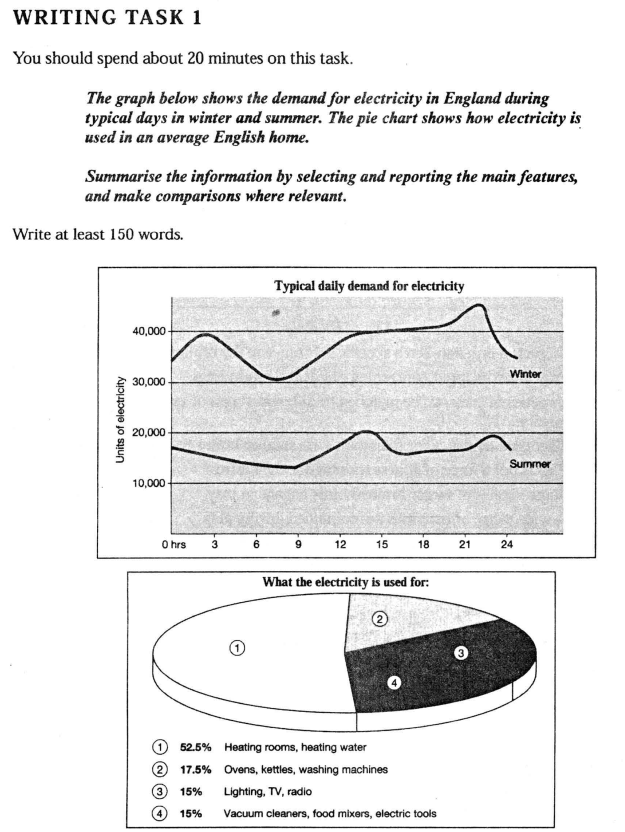 The line graph illustrates the daily electricity demand in England during typical winter and summer days, while the pie chart outlines electricity usage in an average English household.
The line chart shows that(the) demand for electricity in England ranging example days(on a typical day) in winter and summer. From this chart, we can see a(the) same changing(overall) tendency overall in (both) winter and summer, although the electricity demanding(demand) in winter is always larger(higher) than that in summer. Specifically, the demand in winter tauchs(touches) the bottom in(at) 9’clock(9:00) approximately and go to the peak in(at) 21’clock. The demand in summer also takes(reaches) the bottom in 9’clock, but there are two peaks in(at) 14’clock and 23’clock seperately(separately).
Overall, demand is significantly higher in winter than in summer. In winter, electricity consumption starts at around 35,000 units, rises to an early morning peak, and drops to a low of approximately 30,000 units at 9:00. It then rises steadily to reach a peak of roughly 45,000 units around 21:00. In contrast, summer demand remains lower, fluctuating between 13,000 and 20,000 units, with notable peaks at 14:00 and 23:00.
The pie chart record(s) the percentage of electricity where does it is used. The largest part is used to(for) heating rooms and heating water (52.5%), and the usage of ovens, kettles, and washing machines (17.5%) is (slightly) larger slightly than that in lightning(lighting), TV, and radio (15%) and vacuum cleaners, food mixers, and electric tools (15%). Overall, the most of electricity is used to(for) keeping the warm(ness) of home, and other parts are used to(for) living or(and) entertainment.
The pie chart displays the specific breakdown of electricity consumption. The majority of energy (52.5%) is used for heating rooms and water. Kitchen and laundry appliances, such as ovens and washing machines, account for 17.5%. The remaining 30% is split equally between lighting, TV, and radio (15%) and other appliances like vacuum cleaners and electric tools (15%). In summary, heating is by far the primary energy expense in English homes.
The line graph compares the typical daily demands for electricity in winter and summer in England. As can be seen, the electricity consumption in winter almost doubles that in summer at any given moment of a day. The former waves between 30,000 and 45,000 units, while the latter fluctuates between 13,000 and 20,000 units. Their development trends see more similarities than differences. From 0 to 9 o’clock, both curves move generally downward to the lowest points of more than 30,000 units and 13,000 units, and from then on, the two lines go roughly upward, respectively to the highest amount of 45,000 units at 21 o’clock and more than 20,000 at 13 o’clock. The pie chart reflects an average household use of electricity in England. Heating for both room and water accounts for the biggest share of more than half. The other half of electricity is almost evenly used for three sections: ovens, kettles, washing machines; lighting, TV, radio; and vacuum cleaners, food mixers, electric tools. The first section consumes a little bit higher of 17.5% while the rest two have an equal share of 15%. From the two charts, it is clear that electricity is in higher demand in winter in England.
 The table gives a breakdown of the different types of family who were living in poverty in Australia in 1999. On average, 11% of all households, comprising almost two million people, were in this position. However, those consisting of only one parent or a single adult had almost double this proportion of poor people, with 21% and 19% respectively. Couples generally tended to be better off, with lower poverty levels for couples without children (7%) than those with children (12%). It is noticeable that for both types of household with children, a higher than average proportion were living in poverty at this time. Older people were generally less likely to be poor, though once again the trend favoured elderly couples (only 4%) rather than single elderly people (6%). Overall the table suggests that households of single adults and those with children were more likely to be living in poverty than those consisting of couples.
 The bar chart shows the proportion(s) of different levels of post-school qualifications within(among/for) men and women in Australia in 1999. The bar chart illustrates the proportion of Australian men and women holding different levels of post-school qualifications in the year 1999. The data is divided into five categories, ranging from skilled vocational diplomas to master’s degrees.
First of all, the men waswere more likely to have a top-rank diploma (e.g., postgraduate diploma, master’s degree) and a low-rank diploma (skilled vocational diploma), and the women usually has(have) a moderate ranked diploma such as undergraduate diploma and bachelor’s degree.
Overall, there was a clear gender disparity in the types of qualifications held. Men were the dominant group in both the lowest (vocational) and highest (postgraduate/master’s) levels of education. In contrast, women held the majority of intermediate qualifications, specifically undergraduate diplomas and bachelor’s degrees.
Specifically, the proportion of women who had a skilled vocational diploma (10%) iswas definitely less than that of men (90%). In contrast, the women who had a more proportion inof undergraduate diploma (70%) and bachelor’s degree (about 55%) than those of men (35% and 45% respectively). However, in a more(higher) educational levels such as postgraduate diploma and master’s degree, the males’ part is larger than females (70% vs. 30% and 60% vs. 40%).
Specifically, regarding skilled vocational diplomas, the gap between genders was the widest. Men accounted for approximately 90% of these holders, leaving only 10% for women. Similarly, men outnumbered women in advanced academic degrees. Males comprised roughly 70% of postgraduate diploma holders and about 60% of those with a master’s degree, while females represented 30% and 40% respectively. On the other hand, women surpassed men in undergraduate-level studies. Females held approximately 70% of undergraduate diplomas, which was more than double the figure for men (around 35-40%). The gender distribution was more balanced for bachelor’s degrees, though women still held the majority at roughly 55%, compared to 45% for men.
The chart gives information about post-school qualifications in terms of the different levels of further education reached by men and women in Australia in 1999. We can see immediately that there were substantial differences in the proportion of men and women at different levels. The biggest gender difference is at the lowest post-school level, where 90% of those who held a skilled vocational diploma were men, compared with only 10% of women. By contrast, more women held undergraduated diplomas (70%) and marginally more women reached degree level(55%). At the higher level of education, men with postgraduate diplomas clearly outnumbered their female counterparts (70% and 30%, respectively), and also constituted 60% of Master’s graduates. Thus we can see that more men than women hold qualifications at the lower and higher levels of education, while more women reach undergraduate diploma level than men. The gender difference is smallest at the level of Bachelor’s degree, however.
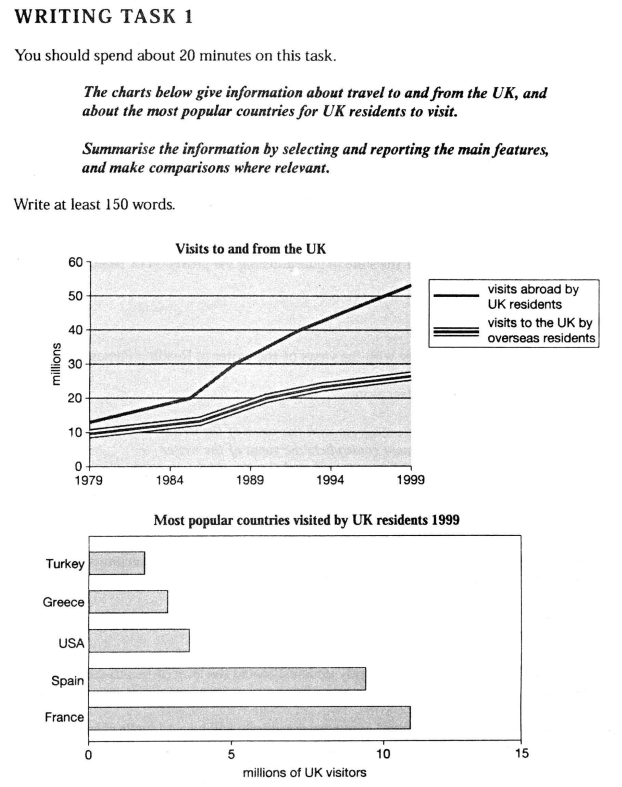 The line chart compares the visits to and from the UK from 1979 to 1999. Visits both to and from the UK have been in constant increase, while visits abroad by UK residents always surpassed that to the UK by overseas residents. From 1979 to 1985, both figures rose from 12 to 20 million and from 10 to 12 million respectively. Since then, both moved substantially upward with the overseas visits by UK residents increasing by a larger scale. As is shown in the bar chart, among the five most popular countries visited by the UK residents, the country with the largest number of British tourists was France (around 11 million), followed by Spain (around 9.5 million). USA, Greece and Turkey lagged far behind, with tourists amounting to 3.5 million, 2.5 million and 2 million respectively. In general, the figure of visits to and from the UK was on the rise, with UK residents abroad outnumbering overseas visitors in the UK and the most popular destination country for UK residents were France and Spain.
 老人:the elderly(集合名词,后跟复数动词)elderly people(people是复数名词) older people(除非特指,否则不加the)the old / old people 口语且不礼貌 USA和US前要加the,本质是the + 形容词 + 复数普通名词,所以荷兰也是the Netherlands 具体来说:In particular; Specifically; To be more specific; More specifically; Namely
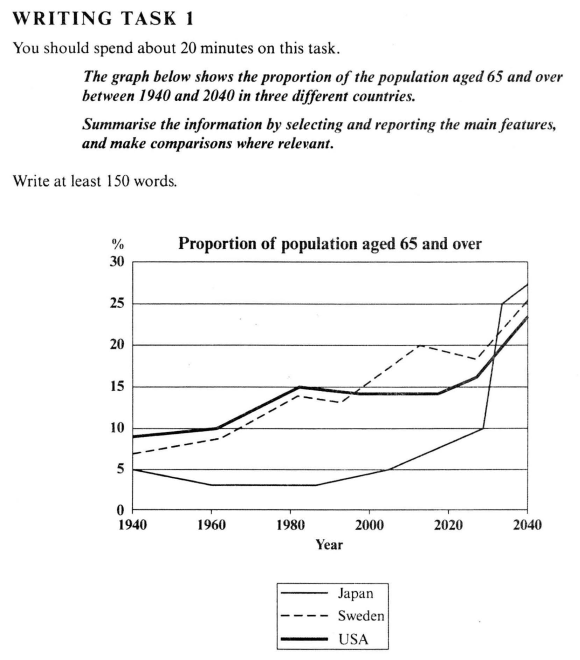
The line chart shows the changing proportion of the elderly people who age and surpass 65(are aged 65 and over/aged 65 and above) in three countries between 1940 and 2040.
The line graph illustrates the proportion of the population aged 65 and over in three distinct countries—the USA, Sweden, and Japan—over a century, from 1940 to a projected date of 2040.
In general, the proportion of these old(elderly) people move(s) slowly upward in (the) USA and Sweden from 1940 to 2040. In contrast, it is steady that the proportion in Japan between 1940 and 2000(the proportion remained steady), and then this proportion rocked fast(rose sharply/increased rapidly) and it will reach the(a) peak (around 25%) in 2040 recording(according) to the prediction.
Overall, the population of elderly people is on the rise in all three nations. While the USA and Sweden show a gradual upward trend throughout the period, Japan displays a unique pattern: its elderly population remains low for decades before experiencing a dramatic surge in the 21st century, eventually becoming the country with the highest elderly demographic.
In specific(In detail/Specifically), the proportion in (the) USA increased from 1940 (around 10%) to 1980 (around 15%) and keeped(kept) unchanged until 2020, and finally will go to approximate(ly) 25% in 2040. It is the same proportion in Sweden in all period(throughout the whole period/over the entire period) in this graph except (in/for) 2010 where its proportion had a small peak.
Specifically, in 1940, the USA had the highest proportion of seniors at roughly 9%, compared to Sweden’s 7%. Both countries saw steady growth until 1980. However, while the USA’s figure plateaued at 15% between 1980 and 2015, Sweden’s rate continued to climb, overtaking the USA and reaching nearly 20% by 2010. By 2040, Sweden is projected to reach about 25%, while the USA is expected to rise to approximately 23%.
In conclusion, all of these figures in three different countries generally experienced increase(an increase/increases) from 1940 to future 2040.
Japan shows the most striking change. In 1940, only 5% of its population was over 65. This figure dipped to around 3% and remained the lowest among the three nations until the early 2000s. However, starting around 2030, the percentage is forecast to skyrocket, overtaking both Western nations to peak at roughly 27% by 2040.
The graph shows the increase in the aging population in Japan, Sweden and the USA. It indicates that the percentage of elderly people in all three countries is expected to increase to almost 25% of the respective populations by the year 2040. In 1940 the proportion of people aged 65 or more stood at only 5% in Japan, approximately 7% in Sweden and 9% in the US. However, while the figures for the Western countries grew to about 15% in around 1990, the figure for Japan dipped to only 2.5% for much of this period, before rising to almost 5% again at the present time. In spite of some fluctuation in the expected percentages, the proportion of older people will probably continue to increase in the next two decades in the three countries. A more dramatic rise is predicted between 2030 and 2040 in Japan, by which time it is thought that the proportion of elderly people will be similar in the three countries.
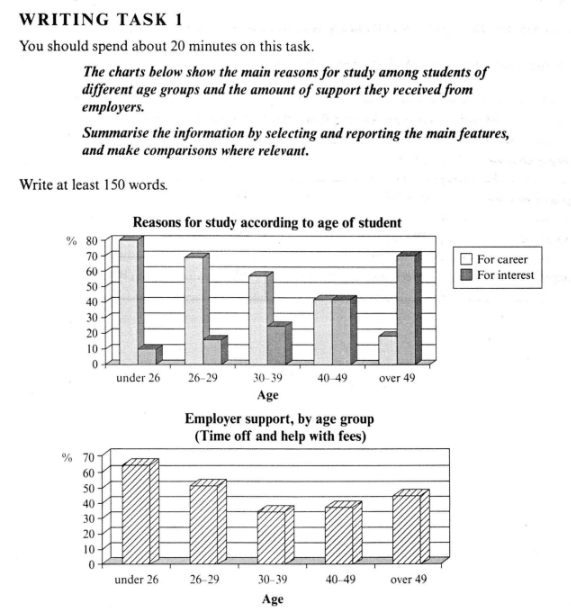 The two bar charts illustrate the primary reasons why students of different age groups choose to study, as well as the level of financial and time-off support they receive from their employers. Overall, there is a clear inverse relationship between age and career motivation: younger students study primarily for career advancement, while older students are driven by personal interest. Regarding employer support, the youngest age group receives the most assistance, while middle-aged employees receive the least.
The first bar chart showes(shows) that with the increase of age(with increasing age/as age increases), the interest proportion of supporting people to study grows steadly(steadily) and reach(es) the(a) peak at the age over 49(among people aged over 49) (around 70%). In contrast, the people who go to study for career become less and less(the proportion of people studying for career purposes decreases), and this proportion at the age(among those aged) under 26 (around 80%) continuely(continuously) decrease(s) to about 20% when people aged over 49.
Regarding the reasons for education, the first chart shows that studying for personal interest rises steadily with age. Only about 10% of those under 26 study for interest, but this figure reaches a peak of 70% for those over 49. In contrast, the percentage of students studying for career purposes declines significantly with age. While 80% of students under 26 cite career as their main motivation, this figure continuously decreases, dropping to just over 10% for the oldest age group.
Furthermore, the second graph represents the amount of support (that) people who go to study recived(received) from their employers. It shows that at middle age such as from 30 to 39 and from 40 to 49, people recieve(receive) the least money aids(financial support) from their boss(employers), and these figures are both at approximately 35%. In addition, people that(who) aged under 26 can get the largest fees(support) from their authorities(employers), it(which) is about 60%. And finally, the people who are aged from 26 to 29 and over 49 can get a counterpartial(moderate level of) support, these data are 50% and 40% seperately(separately).
The second chart details the support received from employers. Employees aged under 26 benefit from the highest level of support, at approximately 60%. This support drops for the 26-29 age group (around 50%) and hits a low point for middle-aged employees (30-39 and 40-49), who receive only about 32% support. Finally, support levels rise slightly for the oldest group (over 49) to roughly 45%, which is comparable to the support received by those in their late twenties.
The bar charts indicate the reasons for study among different age groups and employer support to them. The first chart shows nearly 80% of students under 26 study for their career. This percentage gradually declines with the increase in age. Conversely, study stemming from interest increases with age. There are only 10% of students under 26 studying out of interest. The percentage grows steadily to 40% among those in their 40s, almost the same as those studying for career. Among students over 49, 70% of them study for interest in comparison to 18% for career reasons in that age group. The second chart shows that employer support is maximum (approximately 60%) for students under 26. The percentage drops rapidly to 32% for students between 30 and 39, and then increases in late adulthood up to about 44%. It is unclear whether employer support is only for career-focused study, but the highest level is for those students who mainly study for career purposes.
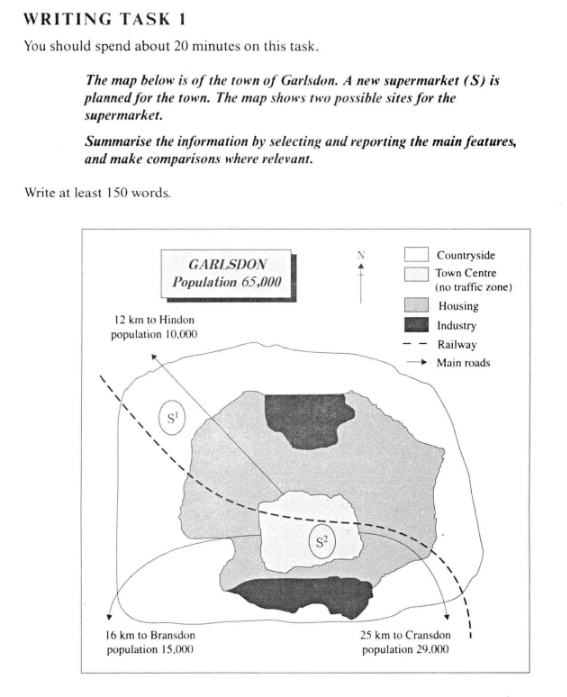 The map above shows two alternatives for building (a) supermarket and their surrounding enviro(n)ment. The map illustrates two potential sites ( and ) for a proposed new supermarket in the town of Garlsdon, along with the surrounding infrastructure and population demographics.
From the information mentioned in (shown on) this map, we can see that alternative 1 location is situated in (the) countryside and (to) the northwest of Garlsdon town. In addition, the nearest town of alternative 1 is Hindon which has a population (of) 10,000 and (is) located in(to) the northwest of it. In contrast, alternative 2 is located in the town center of Garlsdon, which is also (the) center of the map. And there are two industrial distributions(areas/zones) located in(to) its ~~~right~~~(directly) north and right(directly) south separately. Furthermore, alternative 2 is surrounded by much(many) housing area(s) and has a approximately (the) same distances from its neighbour(ing) towns, Hindon, Bransdon and Cransdon. Comparing to(Compared with/to) alternative 1, alternative 2 is more likely (to) be visited by citizens in the town because its center attribute and many people in other two towns can engaged(visit/be attracted) in(to) the supermarket. Finally, both sites have a convenient transportation, which is comrised(comprised) by main roads and railway.
The first potential location () is situated in the countryside, to the northwest of Garlsdon. It lies directly on the main road connecting Garlsdon to the smaller town of Hindon (population 10,000). Notably, is located near the railway line that runs through the region, potentially offering rail access for goods or commuters. However, it is quite far from the main residential areas of Garlsdon. In contrast, the second site () is located in the heart of Garlsdon’s town centre. This area is designated as a “no traffic zone,” which implies that car access might be restricted for shoppers. The site is surrounded by residential housing, with industrial zones located immediately to the north and south. Unlike , this site is not near the railway line but is centrally located relative to the neighboring towns of Bransdon and Cransdon. Overall, the main difference is that is an out-of-town site with good road and rail access suitable for Hindon residents, while is a central urban site surrounded by Garlsdon’s housing but hindered by traffic restrictions.
The map shows two proposed locations for a new supermarket for the town of Garlsdon. The first potential location (S1) is outside the town iteself, and is sited just off the main road to the town of Hindon, lying 12 kms to the north-west. This would make it accessible to shoppers from both Hindon and Garlsdon who could travel by car. As it is also close to the railway line linking the two towns to Cransdon (25km to the south-east), a potentially large number of shoppers would also be able to travel by train. In contrast, the suggested location, S2, is right in the town centre, which would be good for local residents. Theoretically the store could be accessed by road or rail from the surrounding towns, including Bransdon, but as the central area is a no-traffic zone, cars would be unable to park and access would be difficult. Overall, neither site is appropriate for all the towns, but for customers in Cransdon, Hindon and Garlsdon, the out-of-town site (S1) would probably offer more advantages.

This table above shows some numeric information about the underground railway systems in six cities. First, it is clearly evident that London is the first city which built the underground railway in 1863. And most of (the) other cities built the railway in (the) 20 century, they are seperately(separately) in 1900 (Paris), 1927 (Tokyo), 1976 (Washington DC), and 1981 (Kyoto). Los Angeles constructed its railway system until(in the) 21 century, so its route kilometers(length) and passengers per year were both in the least(lowest) tier, 28 kilometers and 50 million respectively. Furthermore, London had the longest route which is 394 kilometers, and Kyoto had the shortest route which is 11 kilometers. Other cities had a(the) same level of route length which ranges between 100-200 kilometers. Finally, the passengers in Tokyo who take the railway is(were) the largest, which reached 1928 million people, and then is(followed by) 1191 million of Paris and 775 million of London. This figure in Washington DC and Kyoto both does not surpass 200 million, (and) they are 144 million and 45 million respectively.
The table provides information regarding the underground railway systems in six major cities around the world, detailing their opening dates, route lengths in kilometers, and annual passenger numbers in millions. Overall, the data shows significant variations in the age, size, and usage of these systems. While London has the oldest and most extensive network, the Tokyo system carries the highest annual volume of passengers by a wide margin. Looking first at the age and size of the systems, London’s underground is the oldest, opened in 1863, and also the longest with 394 kilometers of route. Paris followed in 1900 with 199 km. The other systems are younger and generally shorter: Tokyo (1927) has 155 km, while Washington DC (1976) has 126 km. The newest systems are in Kyoto (1981) and Los Angeles (2001), which are also the shortest, covering only 11 km and 28 km respectively. In terms of passenger traffic, Tokyo’s system is by far the busiest, serving 1927 million passengers per year. Paris and London also have high ridership, with 1191 million and 775 million respectively. In contrast, the systems with shorter routes carry significantly fewer people: Washington DC has 144 million passengers, followed by Los Angeles with 50 million, and finally Kyoto with the lowest figure of 45 million.
The table shows quite a direct relationship between the age of the subway system and the length of track. For example, London, open in 1863 and the oldest, has 394 kilometers of track, while the two most recent systems, Kyoto and Los Angeles, both opened within the last 25 years, are only 11 kilometers and 28 kilometers long respectively. Not surprisingly, the three longest subways carry the three largest absolute numbers of passengers per year. However, the density of passenger traffic, i.e., passengers per year per kilometer of track (PYK) is strikingly variable. Tokyo carries by far the greatest load at approximately 13 million PYK while Washington, with 126 kilometers of track and just 29 kilometers shorter than Tokyo, has only about 1 million PYK, giving it the lightest passenger density of all the six. Paris carries the second densest load at 6 million PYK while Kyoto, in stark contrast to Tokyo, carries only 4 million PYK. London, the oldest system and Los Angeles, the newest are both used at the rate of about 2 million PYK.
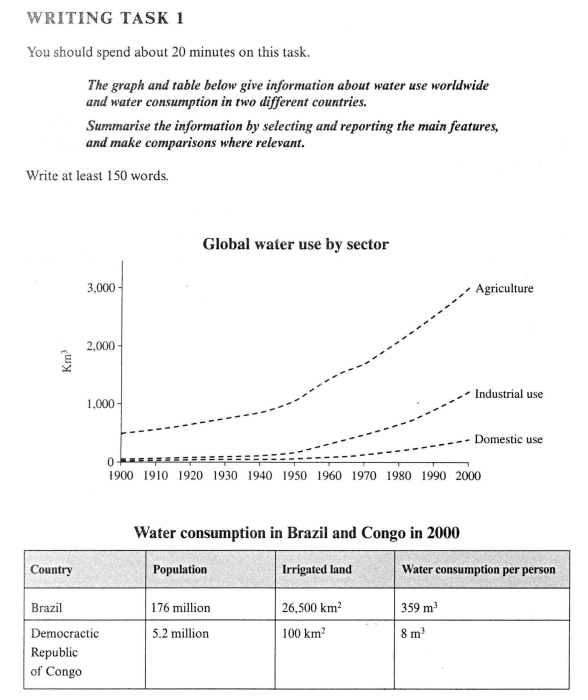 The first line chart shows the changing quantities of water consumption in three different sectors in the world. The line graph illustrates the growth of global water consumption by sector between 1900 and 2000, while the table compares the water consumption and demographics of Brazil and the Democratic Republic of the Congo in the year 2000.
Overall, global water consumption increased dramatically over the century, with agriculture accounting for the largest share. Additionally, the table shows that Brazil had significantly higher water consumption and irrigated land figures than the Congo.
It is clear that (the) agricultural industry consumed the largest part of water resource(s) between 1900 and 2000, and this number rose slightly rapid from around 500 kilometer cubes(cubic kilometers) to about 3000 kilometer cubes(cubic kilometers). In contrast, the water consumption of (the) other two sectors (i.e., industrial use and domestic use) climbed gradually, and these figures in 1900 were both at approximately 0 kilometer cubes(cubic kilometers), and finally in 2000 industrial water usement(usage) reached about 1000 kilometer cubes(cubic kilometers) while domestic water usement(usage) peaked (at) about 300 kilometer cubes(cubic kilometers).
Regarding global usage, the agricultural sector remained the dominant consumer throughout the period. Its consumption rose rapidly, surging from around 500 cubic kilometers in 1900 to approximately 3,000 cubic kilometers in 2000. In contrast, industrial and domestic consumption started at very low levels (near zero). By 2000, industrial usage had climbed to roughly 1,000 cubic kilometers, while domestic usage reached a peak of about 300 cubic kilometers.
It records some information of(on) water consumption in Brazil and Congo in 2000 in the second table. From this table, we can clearly discern that the water resource(s) of Brazil was richer(more abundant) than that in (the) Democratic Republic of Congo. Although Brazil had a population of 176 million which was significantly larger than 5.2 million in Congo, its water consumption per person, 359 meter cubes(cubic meters), also surpassed Congo’s 8 meter cubes(cubic meters). Furthermore, the irrigated land in Brazil was also larger than that in Congo~~,~~ (;) they were 26,500 kilometer squares(square kilometers) and 100 kilometer squares(square kilometers) separately(respectively).
The table highlights significant disparities between the two nations. Brazil, with a population of 176 million, had a massive irrigated land area of 26,500 square kilometers. In comparison, the Congo had only 5.2 million people and just 100 square kilometers of irrigated land. Consequently, water consumption per person was much higher in Brazil at 359 cubic meters, compared to a mere 8 cubic meters in the Congo.
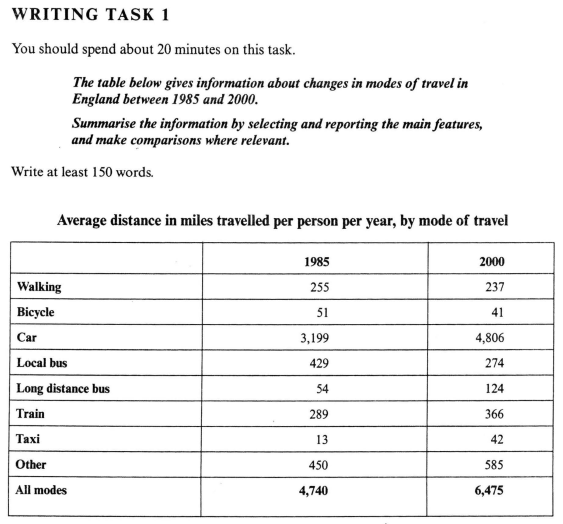 The table above shows the average distance in miles travelled per person per year in 1985 and 2000 in England. The table compares the average distance travelled per person per year in England across different modes of transport between 1985 and 2000.
In general, the distances of all manners of journey(modes of transport/types of journeys) had(showed/experienced) a moderate increase. From the level of all modes(Overall), there was a significant improvement between 1985 and 2000 in numbers from 4,740 to 6,475 miles per person per year.
Overall, the total distance travelled per person increased significantly over the 15-year period. While car travel remained the dominant mode and saw substantial growth, reliance on walking, cycling, and local buses declined.
Furthermore, (travel by) the car, long distance bus, train, taxi, and other modes of travelling(transport) also take(followed) the same pattern as the whole trend; in other words, these means had surged in average distance.
The most significant increase was seen in car travel, which rose from 3,199 miles in 1985 to 4,806 miles in 2000. Other motorized transport also saw growth: train travel increased from 289 to 366 miles, and taxi usage more than tripled, rising from 13 to 42 miles. Long-distance bus travel also more than doubled, reaching 124 miles.
However, the average travel distance by walking and bicycle had a slight decrease. In specific(Specifically), these figures drop(p)ed from 255 miles to 237 miles and from 51 miles to 41 miles separately(respectively) in these two ways. Finally, there was a steep decrease in the average distance travelled per person per year by local bus, and its number had a plummet(experienced a sharp drop) from 429 miles to 274 miles between 1985 to 2000.
In contrast, active transport and local bus services experienced a decline. Local bus travel saw a significant drop, falling from 429 miles to 274 miles. Similarly, the average distance walked decreased slightly from 255 to 237 miles, and cycling figures fell from 51 to 41 miles.
In my view, this situation may be resulted in(result from) the sharp development of high-speed and convenient transport methods.
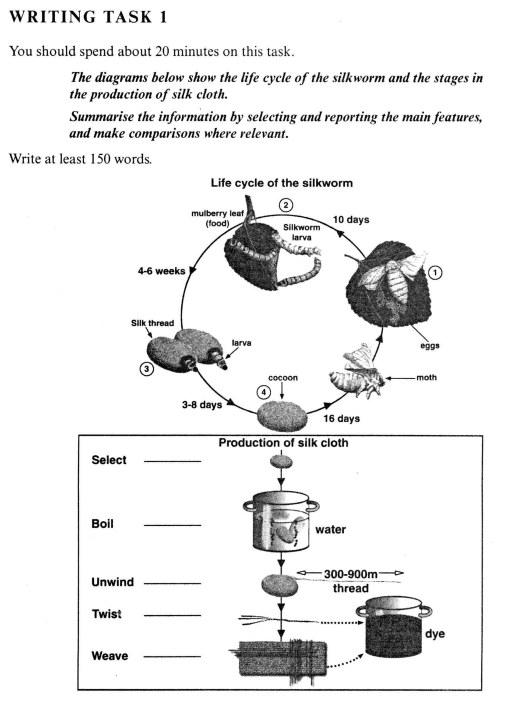 The first diagram shows that there are four main stages in the life of the silkworm. First of all, eggs are poduced by the moth and it takes ten days for each egg to become a silkworm larva that feeds on mulberry leaves. This stage lasts for up to six weeks until the larva produces a cocoon of silk thread around itself. After a period of about three weeks, the adult moths eventually emerge from these cocoons and the life cycle begins again. The cocoons are the raw material used for the production of silk cloth. Once selected, they are boiled in water and the threads can be separated in the unwinding stage. Each thread is between 300 and 900 metres long, which means they can be twisted together, dyed and then used to produce cloth in the weaving stage. Overall, the diagrams show that the cocoon stage of the silkworm can be used to produce silk cloth through a very simple process.

The first bar chart shows the number of marriages and divorces in the USA between 1970 to(and) 2000. There was a gradual decrease in the number of marriages~~;(.) its figure which was 2.5 million in 1970 dropped ,~~(.) (The proportion of ) people who down to roughly 2 million in 2000. In contrast, the number of divorced people(divorces) in America climbed from 1 million in 1970 to approximately 1.5 million in 1980 and then decreased slightly to 1 million in 2000.
The second bar chart records the proportions of marital status of adult(s) in the USA between 1970 and 2000. It is evident that the proportions of married people and widowed people both decreased from 1970 to 2000, and these figures are(were) about 10 percent and about 3 percent respectively. The percentages of (the) other two kinds of marital states(status) increased marginallyare(had) nerver married from about 12 percent in 1970 rose to 20 percent in 2000, while (divorced) people who are in diversed increased significantly from nearly 0 percent in 1970 to roughly 10 percent in 2000.
The first bar chart illustrates the number of marriages and divorces in the USA from 1970 to 2000, while the second chart displays the marital status of American adults in the years 1970 and 2000. Overall, the number of marriages consistently declined over the period, while divorces showed some fluctuation. Consequently, the proportion of married adults decreased significantly, while the percentage of those who were never married or divorced rose. Regarding the first chart, there was a steady decline in marriages. The figure started at 2.5 million in 1970 and dropped to approximately 2 million by 2000. In contrast, the number of divorces initially rose from 1 million in 1970 to a peak of nearly 1.5 million in 1980, before falling back to around 1 million in 2000. The second chart shows a shift in marital status. The proportion of married adults dropped significantly from 70% in 1970 to roughly 60% in 2000. Widowed individuals also saw a slight decrease. Conversely, the percentage of those never married rose from roughly 15% to 20%. Similarly, the proportion of divorced adults increased roughly threefold, rising from about 2-3% in 1970 to nearly 10% in 2000.

This table shows varied proportions of consumer expenditure by category in (five, 数词要放在形容词前面) different five countries in 2002. Through the information that is provided in this table, we can easily discern that the expense in(on) food, drinks, and tobacco accounted for the largest share, and cost(expenditure) in(on) leisure and education was the least part(smallest proportion/lowest share) throughout all the five countries, Ireland, Italy, Spain, Sweden, and Turkey~~, and~~(Meanwhile, spending on clothing and footwear remained at a moderate level) the percentage spending in clothing and footwear was in(at) a moderate stage(level).
The table illustrates the percentage of consumer expenditure across three categories in five different countries in 2002. Overall, it is clear that spending on Food, Drinks, and Tobacco accounted for the largest proportion of expenditure in all five nations, whereas Leisure and Education represented the lowest share. The spending on Clothing and Footwear was moderate in comparison.
Furthermore, these figures (for, figures 不能直接 spend) that spended(spent) on the food, drinks, and tobacco in Ireland and Turkey, which were 28.91 percent and 32.14 percent respectively, almost doubled that in Italy, Spain, and Sweden, which were around 17 percent.
Regarding the largest category, expenditure on Food, Drinks, and Tobacco was highest in Turkey and Ireland, at 32.14% and 28.91% respectively. These figures were nearly double those of the other three countries (Italy, Spain, and Sweden), which all recorded spending of approximately 16% to 19%.
In addition, the proportions of the national consumer expenditure in(on) clothing and footwear among all of the five contries(countries) stayed(remained at) the same level ranging from 5 percent to 10 percent.
In terms of Clothing and Footwear, the figures were relatively similar across the countries, ranging between 5.40% and 9.00%. Italy reported the highest percentage in this category (9.00%), while the others remained below 7%.
At last but not least, considering the leisure and education share, Spain spended(spent) the least money(lowest proportion), and its number(the figure) was 1.98 percent, while Turkey took the most(had/recorded the highest figure at) 4.35 percent which was approximately doubled its figure in(that of) Spain.
Finally, looking at Leisure and Education, Spain spent the least at 1.98%. In contrast, Turkey recorded the highest figure at 4.35%, which was more than double the percentage spent in Spain.
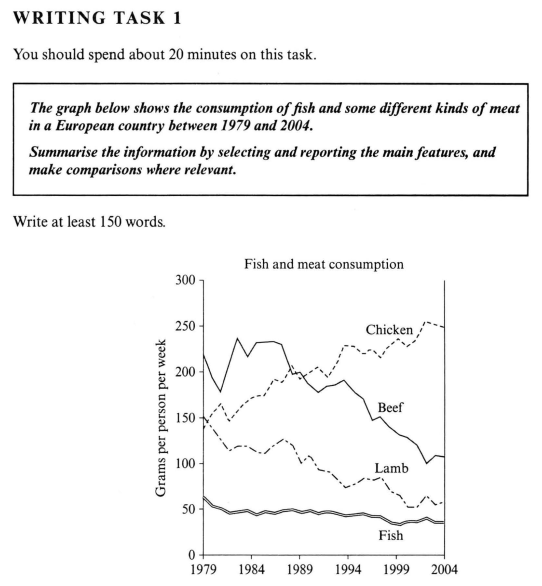
This line graph illustrates the consumption quantities per person per week of fish and (the) other three kinds (three other kinds) of meat in a typical European nation from 1979 to 2004.
The line graph illustrates the weekly consumption of fish and three other kinds of meat per person in a European country between 1979 and 2004.
Overall, it is evident that the consumption of chiken(chicken) rose dramatically and the numbers(consumption) of other meat all decreased with different degrees(to different exents/at different rates) in this country in this period.
Overall, it is evident that the consumption of chicken rose dramatically, while the consumption levels of the other meats all decreased to varying degrees over the period.
In specific(To be specific/In particular, 固定搭配), the consumption of chicken rose significantly from around 150 grams per person per week in 1979 to about 250 grams in 2004.
Specifically, chicken consumption rose significantly, climbing from around 150 grams per person per week in 1979 to peak at approximately 250 grams in 2004.
Furthermore, the amounts of(both) beef consumption and lamb consumption showed the same trend, which was a considerable drop. And(Specifically,) their figures slipped(declined/fell) quickly from about 220 grams and 150 grams per person per week in 1979 to roughly 100 grams and 50 grams in 2004 respectively.
In contrast, beef and lamb followed a downward trend. Beef consumption plummeted from about 220 grams in 1979 to roughly 100 grams in 2004, while lamb fell from 150 grams to just 50 grams over the same timeframe.
In addition, the consumption of fish experienced a slightly reduction, which(and) fluctuated around 50 grams per person per week throughout the whole period between 1979 and 2004.
Finally, the consumption of fish experienced a slight reduction. Figures fluctuated constantly just below 50 grams per person per week throughout the entire period.
The graph illustrates change in the amounts of beef, lamb, chicken, and fish consumed in a particular European country between 1979 and 2004. In 1979 beef was by far the most popular of these foods, with about 225 grams consumed per person per week. Lamb and chicken were eaten in similar quantities (around 150 grams), while much less fish was consumed (just over 50 grams). However, during this 25-year period the consumption of beef and lamb fell dramatically to approximately 100 grams and 55 grams respectively. The consumption of fish also declined, but much less significantly to just below 50 grams, so although it remained the least popular food, consumption levels were the most stable. The consumption of chicken, on the other hand, showed an upward trend, overtaking that of lamb in 1980 and that of beef in 1989. By 2004, it had soared to almost 250 grams per person per week. Overall, the graph shows how the consumption of chicken increased dramatically while the popularity of these other foods decreased over the period.
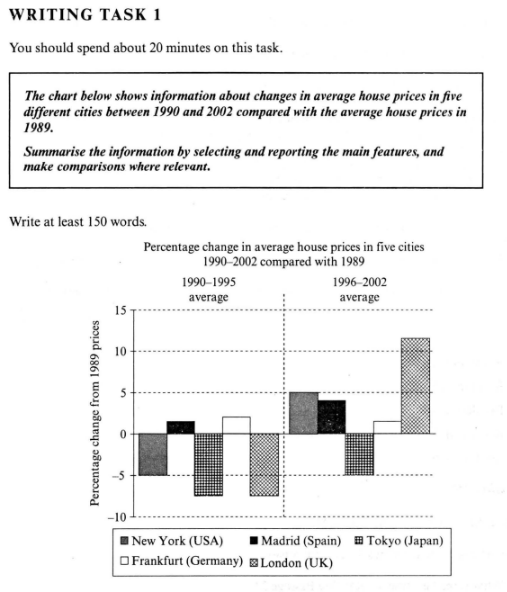
The chart above shows data about changes of(in, 固定搭配) average house prices between 1990 and 2002 compared with the average prices in 1989 in five different cities. Overall, average house prices of two cities during(from) 1990 to 1995 (during 1990-1995) had a slightly increase compared with that in 1989, while prices of three other cities dropped hugely(considerably). Most of the five cities experienced a significant increase in average house prices between 1996 to(and) 2000 compared with that in 1989.
The bar chart compares changes in average house prices in five different cities during two periods (1990-1995 and 1996-2002) against values from 1989. Overall, average house prices in three cities fell significantly in the first period, while the other two saw a slight increase. However, from 1996 to 2002, most cities experienced growth in prices compared to the 1989 baseline.
To be specific, average prices of house in New York, Tokyo and London plunged over 5 percent, and the prices in Madrid and Frankfurt saw a minor increase(, both of) which both were around 2 percent.
Specifically, during the 1990-1995 period, house prices in New York, Tokyo, and London fell by approximately 5% to 7%. In contrast, prices in Madrid and Frankfurt saw a minor increase of around 2% above the 1989 average.
Furthermore, average house price in Tokyo between 1996 and 2002 slipping(slipped) down about 5 percent compared with that in 1989, while (the) other three cities, New York, Madrid, and London, had a monumental increase in this period, and Frankfurt only got a slightly improvement by(in) average house prices compared to that in 1989.
Furthermore, between 1996 and 2002, the average house price in Tokyo continued to drop, falling by 5%. Conversely, the other three cities (New York, Madrid, and London) saw significant increases, with London rising by over 11%. Frankfurt, however, showed only a slight improvement in values compared to 1989.
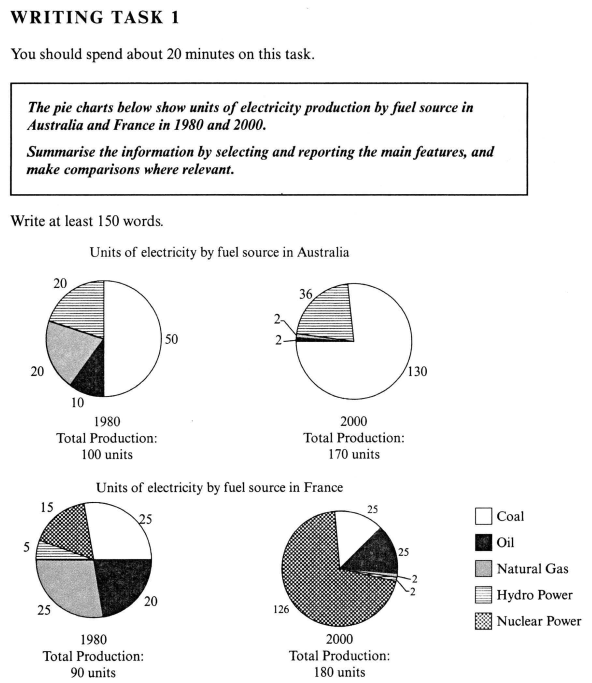
From the pie charts, we can observe (the) units of electricity production by fuel source in Australia and France in 1980 and 2000(,) respectively. Overall, it is evident that there are(were) only four types of fuel source(s) generating electricity in Australia, which were oil, natural gas, hydro power and coal, and the total units of production was 100 units in 1980 and 170 units in 2000. The number of types in France was five(There were five types of fuel scources), which contained(including) nuclear power, and the total (production) is(was) 90 units in 1980 and 180 units in 2000. In other words, the source(s) of electricity in F(r)ance was(were) more varied. Furthermore, coal acounted(accounted) for the most(largest) share of fuel source in Australia both in 1980 and 2000, while the electricity units(generated) by nuclear power climbed from a moderate level in 1980 to the largest part in 2000 in France.
The pie charts compare the electricity production by fuel source in Australia and France in 1980 and 2000. Overall, total production increased in both countries. Australia remained heavily dependent on coal, whereas France shifted its primary reliance to nuclear power over the twenty-year period.
To be specific, the share of hydro power in generating electricity in Australia maintained a steady level(remained relatively stable) in 1980 and 2000, which were 20 units and 36 units respectively, while that of natural gas and oil experienced a considerably(considerable) drop, they slipped(slipping/falling) from 20 units and 10 units in 1980 to both 2 unist(units) in 2000.
In Australia, coal remained the dominant source, rising from 50 units in 1980 to 130 units in 2000. Hydro power increased in total output (20 to 36 units) but remained a secondary source. In contrast, natural gas and oil experienced a considerable drop, falling from 20 and 10 units respectively to just 2 units each in 2000.
In addition, the share of natural gas in the total electricity production in France plunged from 25 units in 1980 to 2 units in 2000, and(while) the other three types of source(s) kept a roughly constant(remained roughly unchanged/relatively constant).
In France, the most significant change was in Nuclear power, which surged from a mere 15 units in 1980 to a massive 126 units in 2000. Meanwhile, Natural Gas plunged from 25 units to just 2. The other sources remained roughly constant, with Coal and Oil standing at 25 units each in 2000.
The charts compare the source of electricity in Australia and France in the years 1980 and 2000. Between these years electricity production almost doubled, rising from 100 units to 170 in Australia, and from 90 to 180 units in France. In 1980 Australia used coal as the main electricity source (50 units) and the remainder was produced from natural gas, hydro power (each producing 20 units) and oil (which produced only 10 units). By 2000, coal had become the fuel for more than 75% of electricity produced and only hydro continued to be another significant source supplying approximately 20%. In contrast, France used coal as a source for only 25 units of electricity in 1980, which was matched by natural gas. The remaining 40 units were produced largely from oil and nuclear power, with hydro contributing only 5 units. But by 2000 nuclear power, producing almost 75% of electricity, at 126 units, while coal and oil together produced only 50 units. Other sources were no longer significant. Overall, it is clear that by 2000 these two countries relied on different principal fuel sources: Australia relied on coal and France on nuclear power.
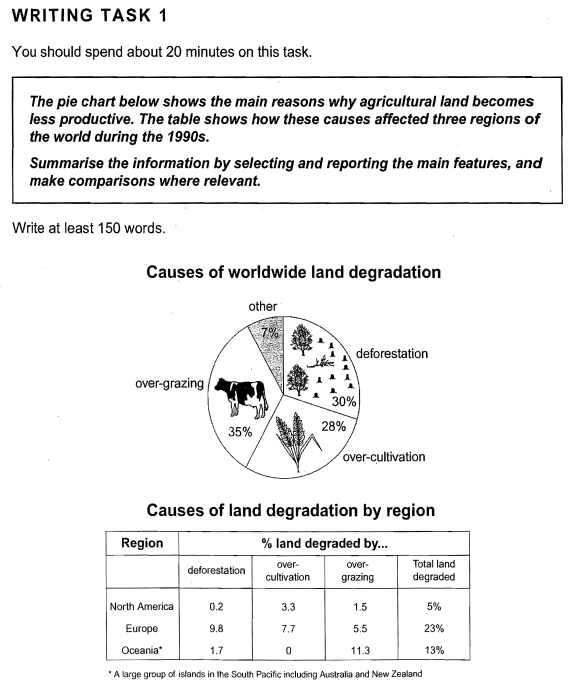
The pie chart shows the breakdown of causes to(of) worldwide land degradation(,) and the table presents the causes of land degradation in(shows how these causes affected) different regions during the 1990s.
The pie chart illustrates the main causes of worldwide land degradation, while the table details how these causes affected three specific regions during the 1990s.
Overall, over-grazing, deforestation and over-cultivation generally contributed a(the) same share in deteriorating the productivity of agricultural land in the world, and these firgures(figures) were 35%, 30% and 28% respectively.
Overall, over-grazing was the primary cause of land degradation globally. Regionally, Europe suffered the most extensive land degradation, whereas North America was the least affected.
Furthermore, other causes maintained(accounted for/made up) a(n) insignificant proportion, which was(at) only 7%. Globally, over-grazing accounted for the largest share of degradation at 35%, closely followed by deforestation (30%) and over-cultivation (28%). Other causes represented an insignificant minority at just 7%.
Regarding(With regard to) to the table, it is evident that agricultural field (land) of(in) Europe experienced a considerable degradation(the highest level of land degradation), which was(at) 23%, while proportions in Oceania and North America were 13% and 5% respectively. To be more specific, proportion of degradated(degraded) land in North America was consisted of 0.2% in deforestation, 3.3% in over-cultivation and 1.5% in over-grazing, while the three causes in Europe accounted for the generally equal shares (9.8%, 7.7% and 5.5%).
Regarding the table, Europe experienced the highest level of degradation (23% of total land), while North America had the lowest (5%). Specifically, degradation in North America consisted of mainly over-cultivation (3.3%), with very little deforestation (0.2%).
However, the pattern of contributions in Oceania was largely(markedly) different from the other two regions, over-grazing took the most significant part which was about 11%, while the share of deforestation lagged with(before at) 1.7%, and the part of over-cultivation was nearly 0(almost negligible).
In contrast, Oceania showed a distinct pattern. Over-grazing was the dominant factor, responsible for 11.3% of degradation. Deforestation was much lower at 1.7%, and over-cultivation was virtually non-existent (0%).
The pie chart shows that there are four main causes of farmland becoming degraded in the world today. Globally, 65% of degradation is caused by too much animal grazing and tree clearance, constituting 35% and 30% respectively. A further 28% of global degradation is due to over-cultivation of crops. Other causes account for only 7% collectively. These causes affected different regions differently in the 1990s, with Europe having as much as 9.8% of degradation due to deforestation, while the impact of this on Oceania and North America was minimal, with only 1.7% and 0.2% of land affected respectively. Europe, with the highest overall percentage of land degraded (23%), also suffered from over-cultivation (7.7%) and over-grazing (5.5%). In contrast, Oceania has 13% of degraded farmland and this was mainly due to over-grazing (11.3%). North America had a lower proportion of degraded land at only 5%, and the main causes of this were over-cultivation (3.3%) and, to a lesser extent, over-grazing (1.5%). Overall, it is clear that Europe suffered more from farmland degradation than the other regions, and the main causes there were deforestation and over-cultivation.
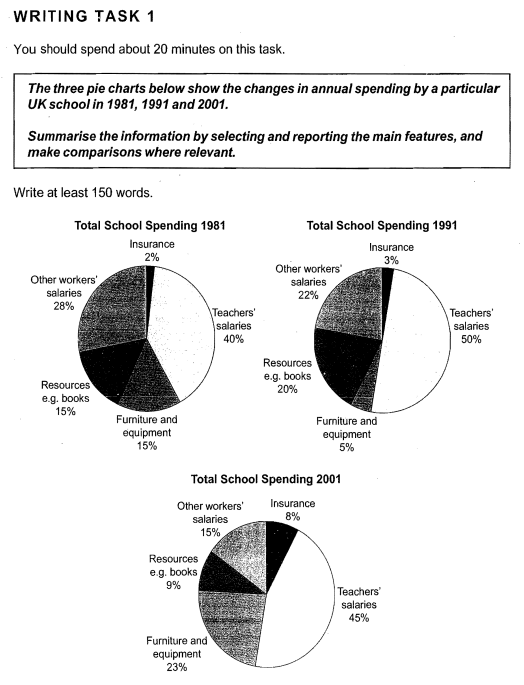
The three pie charts compared (the) breakdown in annual spending by a typical UK school between(in) 1981, 1991 and 2001.
The three pie charts compare the breakdown of annual spending by a typical UK school in 1981, 1991, and 2001.
Overall, we can clearly discern that teachers’ salaries always accounted for the largest share of the total spending in three different years, while the expenditure of insurance constantly took the smallest part in annual spending. Overall, it is clear that teachers’ salaries consistently accounted for the largest share of total spending, while expenditure on insurance represented the smallest portion in all three years.
To be more specific, (the) proportion of teachers’ salaries climbed from 40% in 1981 to 50% in 1991, and finally dropped slightly to 45% in 2001, while that of resources experienced the same trend, it(which) peaked at 20% in 1991 from 15% and finally slipped to 9%. …Resources experienced a similar trend; spending peaked at 20% in 1991 (rising from 15%) before finally slipping to 9% in 2001.
However, the figure of furniture and equipment presented a(n) inverse change, it decreased significantly from 15% in 1981 to a bottom(low) with 5% in 1991, and eventually became the second largest part with 23% in 2001, overtaking the share of other workers’ salaries. However, Furniture and Equipment presented an inverse trend. The figure decreased significantly from 15% in 1981 to a low of 5% in 1991, but eventually rose to become the second largest sector at 23% in 2001, overtaking Other Workers’ Salaries.
Furthermore, insurance shares increased gradually from 2% in 1981 to finally 8% in 2001. In addition, (the) proportion of other workers’ salaries saw a steady incline(decline), which dropped from 28% in 1981 to 22% in 1991, and finally fell to 15% in 2001.
Furthermore, insurance increased gradually from 2% to 8%. In addition, the proportion of Other Workers’ Salaries saw a steady decline, falling from 28% in 1981 to 22% in 1991, and finally to 15% in 2001.
The charts show how much a UK school spent on different running costs in three separate years 1981, 1991 and 2001. In all three years, the greatest expenditure was on staff salaries. But while other workers’ salaries saw a fall from 28% in 1981 to only 15% of spending in 2001, teachers pay remained the biggest cost, reaching 50% of total spending in 1991 and ending at 45% in 2001. Expenditure on resources such as books had increased to 20% by 1991 before decreasing to only 9% by the end of the period. In contrast, the cost of furniture and equipment saw an opposite trend. This cost decreased to only 5% of total expenditure in 1991 but rose dramatically in 2001 when it represented 23% of the school budget. Similarly, the cost of insurance saw a rising trend, growing from only 2% to 8% by 2001. Overall, teachers’ salaries constituted the largest cost of the school, and while spending increased dramatically for equipment and insurance, there were corresponding drops in expenditure on things such as books and on other workers’ salaries.
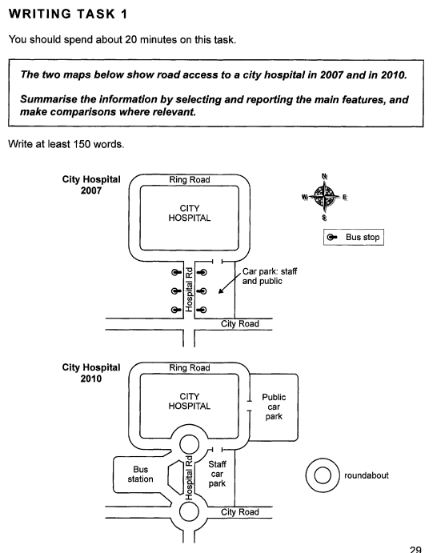
The two maps show the surrounded(surrounding) roads of a city hospital in 2007 and 2010. We can clearly discern that the city hospital were(was) surrounded by a ring road and could be accessed by the hospital road which is(was) a branch of the city road in both 2007 and 2010.
The two maps illustrate the road access to a city hospital in 2007 and 2010. Overall, the hospital infrastructure was significantly upgraded with the addition of a new bus station, two roundabouts, and separate parking facilities.
Regarding to the alteration, the car park to the east of the hospital road mixed(was shared by both) the staff and public in 2007, and by 2010 the public car park was relocated to the east of the city hospital(,) while (the) staff car park (was) situated in the original position.
Regarding the parking facilities, in 2007, there was a single car park to the east of Hospital Road that was shared by both staff and the public. By 2010, this area was designated solely for staff, while a new public car park was constructed on the east side of the hospital, accessible via the Ring Road.
Furthermore, the six bus stops in(on) both sides of the hospital road in 2007 were eliminated and there was a newly built bus station to the west of the hospital road in 2010. The bus station connected the two roundabouts which were newly constructed to(on, side需要用on) the north side (and) south side of the hospital road.
Furthermore, the six bus stops on both sides of Hospital Road were removed. In their place, a new bus station was built to the west of the road. Access was improved by the construction of two roundabouts at the junctions of Hospital Road with the Ring Road (North) and City Road (South).
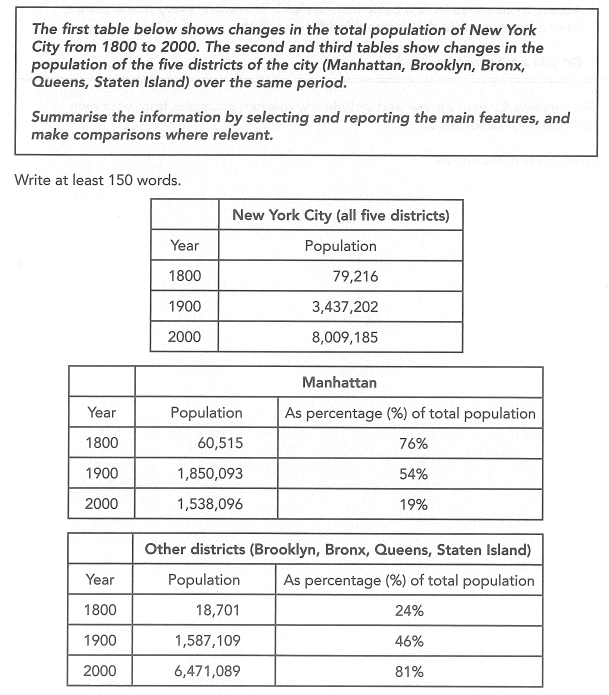
The first table records(shows/illustrates/presents) the total population of New York City in three different years, 1800, 1900 and 2000 respe(c)tively. The latter tables show changes in the populations of Manhattan district and the other four districts (Brooklyn, Bronx, Queens and Staten Island) from 1800 to 2000. We can clearly discern(It is clear) that the population of total city, Manhattan district and the other four districts experienced a large increase(increased significantly/rose dramatically) from 1800 to 2000, while the population of Manhattan saw a slight decrease from 1900 to 2000 and its proportion was overtook(overtaken) by other districts in 2000. To be specific, the total population of New York City surged from 79,216 in 1800 to 3,427,292(3,437,202) in 1900, and finally reached 8,009,185 in 2000. In addition, the figure(population) of Manhattan also had a leap(leaped/experienced a sharp increase/rose sharply) from 60,515 in 1800 to 1,850,093 in 1900, and its proportion maintained the largest share which was(, at) 76% and 54% in these two periods. Furthermore, the sum of other districts’ population(the combined population of the other districts) surged from 18,701 in 1800 to 1,587,109 in 1900, while its proportion (24% and 46%) (was) always less(lower) than that in Manhattan. However, this pattern of share(population distribution/population pattern) shifted in 2000; the population of other districts climbed to 6,471,089 and accounted for 81% of all the city population, overtaking Manhattan’s 1,538,096 and 19%.

The plans illustrate changes of a site in(to the sites of) Beechwood Farm between 1950 and today. There are many newly built buildings at presenst, such as a farm shop, solar panels and so on, and the farm (was) developed a tourist-friendly environment where tracks were replaced by roads and sheep fields are(were) replaced by (a) camping field. To be more specific, the areas of fruit trees, soft fruits, vegetables, chickens and farmhouse (were) maintained unchanged. The place(location) of (the) barn was changed to the bottom of the road cross(junction), while its original palce(place) was used as holiday cottages. In addition, there was a new farm shop in(at) the top of the fruit trees area. Furthermore, the sheep fields were delated(deleted/removed) and distracted(decomposed/converted) to a camping field and (a) solar panels area, and two parking areas were constructed in(to) the left of the camping field and in(at) the bottom of the solar panels area respectively. Finally, the river and highway surrounded(surrounding) the farm stayed unchanged, while tracks in the center of the farm were rebuilt into roads for cars.
Task 2 writing
Title: Some people think the newly built houses should be the same as the old houses in local areas. Others argue that local authorities should allow people to build houses in their own style. Discuss both views and give your opinion.
With the rapid development of economy and citilization(urbanization), there are some debates about the house style in the newly built constructions. Some people support the idea that newly built houses should be more likely to be the style of the old houses in local areas, but others think local authorities should give the freedom to people to chose(choose) their own style. In my point, diversed styles of constructions will play an important role in shaping a colorful city view, so I stay with the later(latter) argument.
With rapid economic development and urbanization, there is an ongoing debate regarding the architectural style of new constructions. Some argue that new buildings should conform to the style of existing old houses, while others believe local authorities should grant individuals the freedom to choose their own designs. In my opinion, diverse architectural styles play a crucial role in creating a vibrant cityscape; therefore, I align with the latter argument.
Keeping the styles of new houses as same as(the same as) the old houses in one area will decrease the cost of construction. As there is no demand in(for) careful designing(design) and bulding(construction), which can lead to higher economic pressure in local authorities and citizens.(there is no main clause) In addition, the standard and indifferent(indistinctive) styles of building can (be) used as a strong point to marketing the city, which can acctract(attract) more tourists to improve the overall economic environment.
Standardizing new houses to match the old ones can indeed reduce construction costs. Since there is less need for unique designs, it alleviates economic pressure on both local authorities and citizens. Furthermore, a uniform architectural style can serve as a strong marketing point for the city, potentially attracting more tourists by preserving the area’s historical integrity and improving the overall economic environment.
On the other hand, allowing people to build houses in their own style can satisfy most citizens’ needs of aesthetics. Becuase in a developed society, everyone is looking forward to seeking a customized form of house to satisfy their pursuit of beauty (there is no main clause). Furthermore, giving the style freedom of house building to citizens can reduce the administration(administrative) pressure of local authorities. There is no doubt that controlling the same style of houses will make the government spend too much costs(money) and human force. This resources can (be) used to provide a well being of citizens instead of taking control of the form of the houses.
On the other hand, allowing people to build in their own style can satisfy citizens’ aesthetic needs. In a modern society, individuals often seek customized housing to reflect their personal taste. Moreover, granting architectural freedom can reduce administrative burdens. Enforcing strict style regulations requires significant government funding and manpower. These resources could instead be used to improve public welfare rather than regulating the appearance of private homes.
In conclusion, I strongly believe that the freedom of style choice can result out(in) a more colorful neibourhood(neighbourhood) sight, which can benefits not only the citizens but also the local government from the aesthetic aspect and administration aspect.
In conclusion, I strongly believe that freedom of choice results in a more diverse and colorful neighborhood, which benefits not only the citizens aesthetically but also the local government administratively.
在我看来: In my view; In my opinion; In my perspective; In(From) my point of view; 人力资源: manpower; human resource
Title: In many places, people’s lifestyle is changing rapidly, and this affects family relationships. Do you think the advantages of such developments outweigh the disadvantages?
With the rapid developent(development) of science and technology, the lifestyle of people in many places has changed quickly. And this change can improve the relationships of family in some tiny aspects, but in my view, the disadvanteges(disadvantages) of this change outweigh the advantages.
With the rapid development of science and technology, people’s lifestyles in many regions have changed significantly. While these changes can improve family relationships in some minor aspects, in my view, the disadvantages of this shift outweigh the advantages.
First of all, the urbanization of society leads to many people work(ing) and live(ing) in cities instead of (the) countryside, therefore they can pay more attention to their small family than villagers. Because there is no need to do some tough work with many people to live a life, in other word(s), people can only (carefully) maintain carefully the relationships between family partners(members). Besides, more and more people make heavy efforts to keep their physical health, and this health will make promisingly the relationships in family longer and more continuous.
First of all, urbanization leads to many people working and living in cities rather than the countryside, which allows them to focus more on their nuclear families. Since there is less need for collective agricultural labor involving large groups, people can dedicate more energy to carefully maintaining relationships with their immediate family members. Additionally, as people place more emphasis on physical health, increased longevity can help sustain family relationships for a longer period.
On the other hand, teenagers are more likely to live a singular life and don’t live with their parents, this(which) will cause a decreation(decrease) of(in) family connection. In addition, the overwork in modern society will decline(reduce/limit/decrease) the opportunity for people to meet their family face to face even (if) they live in a house. Consequently, the relationships in family will become more and more delicate(fragile/weaker).
On the other hand, young people are more likely to lead independent lives away from their parents, which causes a decrease in family connection. In addition, the culture of overwork in modern society reduces the opportunity for face-to-face interaction, even when family members live in the same house. Consequently, family bonds may become increasingly fragile.
In conclusion, although people can pay more attention to their small family rather than big clan, but the lonely lifestyle will largely destroy(weaken/damage) the relationship within the family. So I think the disadvantages of the rapid changing(changes) in lifestyle will defeat the advantages.(although … but … 不能同时使用)
In conclusion, although people may pay more attention to their immediate family rather than the extended clan, the isolation of modern lifestyles can significantly damage family bonds. Therefore, I believe the disadvantages of these rapid lifestyle changes outweigh the advantages.
In recent years, quick changes in the way people live have inevitably impacted family relationships. While these changes are not without drawbacks, I believe the benefits they bring largely outweigh the disadvantages. One major advantage is the improvement in communication within families. Technologies such as video calls and instant messaging have enabled family members, especially those living apart, to maintain close and frequent contact. For instance, migrant workers or parents working elsewhere can now see and talk to their children daily, which could narrow emotional distance despite physical separation. Similarly, students studying overseas can easily share their lives with their families in real time, reducing feelings of isolation. Another benefit lies in the growing equality within family roles. Modern lifestyles have reshaped traditional expectations. Women are no longer confined to domestic duties, and men increasingly participate in household chores and parenting. This shift fosters mutual understanding and reduces conflicts caused by imbalanced responsibilities. When both partners contribute equally, family harmony can be strengthened. Moreover, lifestyle diversification has introduced new opportunities for family bonding. Activities such as weekend travel and online gaming provide meaningful ways for families to connect beyond conventional routines. Engaging in these experiences can build shared memories and a stronger sense of belonging. Admittedly, a fast-paced lifestyle has made quality family time more fragmented. Many people are preoccupied with work even during personal hours, leading to shallow interactions—being physically present but emotionally distant. However, this issue is often a matter of choice and time management rather than an unavoidable outcome of modern life. In conclusion, although certain changes in lifestyle may reduce face-to-face interaction, the overall impact on family relationships is largely positive. By adapting consciously, families can enjoy greater connection, equality, and shared experiences in today’s dynamic world.
Title: Improving the lives of human being is more important than protecting the animal and birds. What extend do you agree or disagree?
Discussing(及物动词不能加about) about which is more important, between improving the lives of human beings and(or) protecting the animal and birds has been popular in recent years. In(From) my point of view, the importance of people is definitely outweigh(s) that of the animals and birds.
**Debates regarding whether improving human lives takes precedence over wildlife conservation have become increasingly common. While environmental protection is valuable, from my perspective, the welfare of human beings definitely outweighs that of animals and birds, as human survival and progress must be the priority.**
First of all, protecting the animals and birds only contributes to the diversity of creatures in the earth, and the final goal of this diversity is also to service(serve) human needs of curiosity and sympathy. Therefore it is a more straight(direct) method to elevate the lives of people rather than passing(instead of) protecting the animal. In addition, human beings are the dominator(dominant species) of the earth, there is no doubt that we can put ourselves into the first place instead of the secondary position. As seeking well-being is the nature of human.
First of all, human beings are the dominant species on Earth, and it is natural to prioritize our own survival and well-being. Many people in developing nations still suffer from poverty, disease, and starvation. Therefore, resources should primarily be directed toward solving these humanitarian crises rather than protecting animal habitats. It is ethically justifiable to ensure that all humans have access to basic necessities, such as clean water and medical care, before allocating significant funds to wildlife conservation.
At last but not at least(Last but not least), esc(a)lating the lives of people also can give a hand to reserve(preserve) the broods(breeds/species) of animals and birds. Because with the development of material lives and psychological civilizitions(civilizations) in human society, people are more likely to prevent the extinction of rare animal.
Furthermore, improving human lives often indirectly benefits wildlife. Last but not least, as societies develop economically and intellectually, they tend to care more about the environment. When people are no longer struggling for basic survival, they have the capacity to focus on higher-level concerns, such as ecology. For example, developed nations typically have better regulations for preventing the extinction of rare species compared to impoverished regions where people may hunt endangered animals for food or money.
In conclusion, it is absolutely correct that improving the lives of human beings is more important than protecting the animal and birds. In conclusion, I firmly believe that addressing human needs is of greater importance than animal protection. However, once human living standards are elevated, we will be in a better position to protect the natural world effectively.
Some people argue that improving human living standards should take precedence over protecting wildlife. While I acknowledge that human development is essential, I disagree with the view that it should override the need to preserve animals and birds. In fact, the two goals are not mutually exclusive but deeply interconnected. Admittedly, in situations of extreme poverty or hunger, immediate human needs may take priority. However, this does not mean that environmental and wildlife protection should be abandoned. Often, the root cause of these challenges lies not in a lack of resources, but in their unfair distribution and unsustainable use. Sacrificing ecological integrity to meet short-term goals can lead to long-term consequences that further threaten human well-being. Protecting animals and birds is fundamental to sustaining human life. Wildlife plays a vital role in maintaining ecological balance. Disrupting these natural systems through deforestation or pollution may result in reduced crop yields, natural disasters, and widespread health problems, all of which directly harm human lives. Moreover, biodiversity offers practical benefits. Many life-saving medicines are derived from wild plants, and genetic diversity in animals is essential for future food security. Preserving wildlife ensures that humanity retains access to these valuable resources. Rather than being a trade-off, human progress and wildlife conservation can support each other. With advancements in green technology and sustainable practices, we can promote eco-friendly agriculture, reduce pollution, and create jobs—improving lives while protecting nature. In conclusion, protecting animals and birds is not a barrier to human progress but a necessary condition for it. A truly improved life includes not only material comfort but also a healthy, sustainable environment for present and future generations.
Title: An increasing number of developing countries are expanding their tourist industry. Why is this the case? Do you think it is a positive development?
In recent years, many developing countries have actively invested in their tourism industries. This trend is primarily driven by the need to accelerate economic growth, generate employment, and enhance international visibility. Overall, this is largely a positive development, although it requires careful management to be sustainable. One of the main reasons developing nations focus on tourism is its potential to generate significant revenue. International tourists contribute directly to the economy through spending on accommodation, transportation, and local attractions. For example, in Thailand, tourism has become one of the largest sources of foreign exchange earnings. Additionally, tourism stimulates the growth of related industries such as hospitality, retail, and food services, thereby creating a multiplier effect across the economy. Another key factor is job creation. As a labor-intensive sector, tourism offers employment to a wide range of people, from highly skilled professionals like tour guides to low-skilled workers in hotels and restaurants. In countries like Indonesia, coastal and island tourism has provided stable income for local communities that previously struggled with poverty and underemployment. Beyond economic gains, tourism can foster cultural exchange and the preservation of local heritage. Countries often gain renewed pride in their identity by showing their traditional crafts, festivals, and customs to a global audience. To remain attractive to tourists, governments may invest in environmental conservation, turning natural resources into long-term assets. In conclusion, the expansion of tourism in developing countries is largely driven by the desire for economic development and employment generation. When managed responsibly, it can also promote cultural preservation and environmental protection. Therefore, this trend should be considered a positive and strategic step toward sustainable national development.
Title: Compare the advantages and disadvantages of three of the following as media for communicating information. State which you consider to be the most effective. comics, books, radio, television, film, theatre
Books, radios and films, as different media of communication, vary considerably in the delivery of information and thus in the results produced. Booke boast the longest history compared with radio programs and films. Books can have a touch upon almost the aspects of our life. Therefore it is no exaggerating to say that the history of books is also the history of human development. But books usually tend to be somewhat slower than the time depicted in them. That may disappoint those who want to acquire the latest information. Films can be the most artistic among the three forms of media as it combines audio, visual and sometimes even special effects. They can get people involved in a more colorful and real world. But unlike books that can be read in the couch of on the bus, movies will not be available without a ticket to the cinema and are shown only once a time. In comparison with books and films, radio can provide the fastest source of information. Radio programs offer weather forecast and domestic and international developments in the fields ranging from presidential election in the U.S. to reform in the banking system in China to protests against humans mistreatment of animals in Europe. Radio is also easier to carry compared with the other two. But in terms of the depth of information carried in it, it is no match for books and films. In conclusion, books make people think, movies let people enjoy and radio helps people live.
Title: In many countries, art galleries visitors have been declining steadily. What are the possible reason? how can we solve this problem?
There is a sharp declination(decline) in the number of art gallaries(galleries) visitors in many countries. From my point of view, there are two main reasons contributing to this result, and also we can resolve this problem by two approaches.
In recent years, there has been a sharp decline in the number of visitors to art galleries in many countries. This trend is concerning as it indicates a disconnection between the public and cultural heritage. In my view, this phenomenon is primarily caused by modern fast-paced lifestyles and high costs, but it can be addressed through educational reform and government subsidies.
At first(Firstly), with the rapid development of economic society, the lifestyle of citizens is becomming(becoming) more and more quick so that people can hardly settle down their heart to appreciate the artistics in the gallaries. In addition, there are so many types of morden(modern) entertainments which cost less money than go(ing) to the galleries that many people will not choose to enjoy the art. For example, people can play the computer game with their friends or work out in the gym; and obviously both of the entertainments cost less even are free.
Firstly, the rapid pace of modern life makes it difficult for people to engage with art. With increased work pressure, citizens often lack the time and patience to appreciate artworks in a quiet gallery setting. Secondly, traditional galleries face stiff(fierce/intensified) competition from modern digital entertainment. Activities such as playing video games or streaming movies are not only more accessible but often cost less than going to a museum. For instance, a monthly subscription to a streaming service is often cheaper than a single gallery ticket, making it a more attractive option for budget-conscious individuals.
To deter the stead(y) declination of galleries visitors, the school should make efforts to develop the level of aesthetics appraciating(appreciation) of students. Furthermore, price reducting(reduction) of tickets should be taken by the gallery to attract more people to engaged in the art, and the government can pay for this expenditure.
To reverse this steady decline, two main measures should be taken. First, schools should focus on cultivating aesthetic appreciation from a young age. By integrating engaging art history lessons into the curriculum, educators can spark students’ interest, making them more likely to visit galleries as adults. Furthermore, financial barriers must be lowered. Galleries should implement ticket price reductions, potentially funded by government subsidies. Offering free entry days or student discounts would encourage more people to engage with art without worrying about the cost.
In conclusion, the quick lifestyle and the expensive cost lead to the decrease of galleries visitors in many countries, and we can solve this problem by elevating students’ affections to art and decreasing the price of gallery tickets. In conclusion, the frantic pace of modern life and the high cost of leisure are the primary drivers behind the drop in gallery attendance. However, by fostering a love for art in schools and making tickets more affordable through government support, we can ensure that art galleries remain vibrant cultural hubs for future generations.
Title: Happiness is considered very important in life. Why is it difficult to define? What factors are important in achieving happiness? Give reasons for your answer and include any relevant examples from your own knowledge or experience.
It is a truism to say that happiness is very important in life. However, it is not an easy concept to define directly, even though we all know when we are happy and when we are unhappy. It has to be defined indirectly, through the things that we normally associate with happiness. These things include such things as looking forward to every day, to enjoying one’s work and life in general, to sleeping well, and to laughing easily. Happiness may also be described as the absence of such negative, unwelcome things as crying, being disappointed in love, feeling under stress and, in extreme cases, clinical depression. These factors are all forms of behavior, feelings or attitudes. Many psychologists and philosophers have paid great attention to what factors are important in achieving happiness, and have written many profound books on the subject. But it seems to me that these factors are in large measure common sense. They include such things as being brought up in a stable, loving family and learning how to enjoy work and study, as well as play. Parents, teachers and other adults also play a very important role in helping children grow up into people who relate well to others, whether strangers, acquaintances, colleagues or friends, and, most importantly, people one falls in love with. They also play a key role in helping young people develop a healthy, constructive attitude to coping with disappointment. The truth of the above has been validated many times in my own personal life. However, I will end with mentioning something I read that might contradict much of it. Some psychologists say each individual is born with a genetically determined ‘happiness level’, to which, after no matter what disappointment or during what suffering, they tend to return to after a period of weeks or months.
Title: Creative artists should always be given the freedom to express their own ideas (in words, pictures, music or film) in whichever way they wish. They should be no government restrictions on what they do. To what extent do you agree or disagree with this opinion?
There are some debates about whether creative artists should be granted the freedom of expressing(to express) their own ideas (in words, pictures, music or films) by(from) the government. From my point of view, I largely agree with the point that there should be no government confinements(restrictions/control) on leteracy(literacy) and art creation.
There is an ongoing debate regarding whether creative artists should be granted total freedom to express their ideas without government intervention. While some argue that censorship is necessary for social stability, from my point of view, I largely agree that there should be no government restrictions on literary and artistic creation, as freedom is the engine of innovation.
First of all, it might bring some detriments to the safety of sociaty(society) if artists are allowed to make artworks in a free way(freely). For example, adolescents who lack the knowledge of value and world may mimic anti-social scenes in these works to bring some destruction to the people. In addition, many people support to impose(ing) some degree of restrictions to art creating as it can lead to a waste of social resources. If there are too many artworks in nonsense fields(, this) will cost not only money but also effort.
Admittedly, opponents of total freedom argue that censorship helps maintain social order. Firstly, unrestricted artistic expression might pose risks to society. For example, adolescents who lack maturity may mimic anti-social or violent scenes found in movies or music, potentially leading to crime. Secondly, some believe that government oversight prevents the waste of social resources on low-quality or offensive art. They argue that without regulation, the market might be flooded with “nonsense” works that consume time and money without offering cultural value.
However, great artworks are more likely to be created in a(n) environment which have(has) little restrictions in my view. It will confine the thought of artists if the government take(s) some strict rules, and then great idea in their hearts will be eliminated. Furthermore, creativity in leteracy(literacy) and art will decrease sharply in the confinements of government. Because the artists have to create artworks in a limited scope, they have no chance to expolre(explore) more wide methods or contents, and this will ultimately lead to an inferior quality of art.
However, I firmly believe that great artworks are most likely to be born in an environment free from restrictions. Strict government rules inevitably confine the imagination of artists, causing brilliant ideas to be extinguished before they can bloom. Furthermore, creativity in literature and art would decrease sharply under censorship. If artists are forced to create within a limited scope defined by officials, they will lose the chance to explore diverse methods or controversial subjects. This suppression would ultimately lead to inferior artistic quality and a culturally stagnant society.
In conclusion, although there are some negatives in giving unlimited freedom to artists, I believe the positives will outweigh the defects awe(owing) to the improved quality of artworks.
In conclusion, although there are valid concerns regarding the potential negative influence of certain artworks, I believe the benefits of artistic freedom outweigh the risks. Owing to the fact that freedom fosters creativity and higher quality art, governments should refrain from imposing restrictions on artists.
On the specific issue of creative freedom versus government restrictions, I am full of the opinion that the latter should give place to the former. Creation is the soul of art. And creation can only be nurtured in an environment of freedom. Human history has shown that the flourishing eras of artistic works were always those accompanied by great freedom, no matter whether ideologically or politically. These artistic creations enriched people’s spiritual life of the time, left the generations to have a valuable legacy, and overall make a good part of human civilization for ever. Without them, human civilization might take on another look undesirable to us all. Nearly any restriction is bound to impede artistic expression. Of all, the most destructive force is from the government with the strong power behind it. Improper government restrictions kill artistic creation. Without artistic creation, people’s spiritual life will be in stagnation. And this will further affect people’s physical life directly or indirectly. Ultimately, the whole society is seen in an appalling state. Those dark ages in human history generally fell into this formula. Therefore, for more colorful life of human beings, artistic creations should be encouraged in freedom. It is the responsibility of the government to help foster such an art-friendly atmosphere, rather than exert(与foster同型) restrictions.
Title: Some people think that violent films and video games have negative effects on people and should be banned. Others think that they are just relaxation sources. Discuss both sides and give your own opinion.
Many people have a point(hold the view/ hold the opinion) that films and video games which have(contain) violence(violent) content have negative effects on people and should be banned. But there exsists(exist) some people (who) think these works play a(an) important role in relaxing people. From my point of view, the advantages of the violent movies and games outweigh their disadvanges(disadvantages).
Many argue that films and video games containing violent content have negative effects on individuals and should be banned. However, others believe that these works play an important role in relaxation. From my point of view, the advantages of violent movies and games outweigh their disadvantages.
First of all, it is a main concern that the violence(violent) content in films and games will be detrimental to the social safety and peace. Specifically, it might tempt students or teenagers who lacks(lack) the right conceiveness(understanding) of world and society to mimic the violence and take some(engage in) dangerous behaviors to harm others’ physical health (harm others physically). Furthermore, people who want to conduct some crimes will learn skills or methods from these violent films and video games and accomplish their crime events(carry out their crimes); and this(which) will lead to severe(serious) social events.
First of all, a primary concern is that violent content in films and games can be detrimental to social safety. Specifically, it might tempt teenagers, who lack a proper understanding of the world, to mimic violent acts and engage in dangerous behavior that harms others. Furthermore, potential criminals might learn methods from these media to commit crimes, leading to severe social consequences.
However, people can benefit from these films and games because they can relax(relieve/ reduce) their mental stress. The fast-pace(fast-paced) lifestyle will constrain people’s lives, and by enjoying the watching or playing, we can mitigate the stress and live not only a physical(ly) healthy life but (also) a mental(ly) healthy life. What’s more, the violent movies and video games can teach people not to do(use) violence with(against) others in their ways. They can show out the bad results of violence, such as losing lives or getting injuries, to youngsters for(to) prevent them from mocking(imitating) these wrong activities.
However, people can benefit from these films and games as they serve as a form of stress relief. The fast-paced modern lifestyle often constrains people’s minds, but by watching movies or playing games, they can mitigate this stress and live a healthier life, both physically and mentally. Moreover, violent media can actually teach people to avoid violence. By depicting the tragic consequences of aggression, such as injury or death, these works can deter young people from imitating such wrong activities.
In conclusion, though there are some defects that (are) caused by violence scenes in movies and video games, I firmly support (the view) that (the) government should give freedom to these entertainments as they can act as a vent method(way to vent) to people’s stress and bad emotions; and finally contribute to human~~‘s~~ well-being and social peace.
In conclusion, although there are some negative aspects caused by violent scenes in media, I firmly support the view that the government should allow these forms of entertainment. They act as an outlet for people’s stress and negative emotions, ultimately contributing to human well-being and social peace.
Violent films and video games have become increasingly popular in modern culture. While there are those who believe such content can foster aggressive behavior and should therefore be banned, others argue that it merely provides a form of recreation. Personally, I think that although violent media may pose certain risks, a total ban would be excessive. On one hand, critics of violent content raise valid concerns about its potential harm. Psychological research suggests that prolonged exposure to violence can lead to desensitization, leading individuals—particularly teenagers—to exhibit aggressive behavior. In some cases, young people have imitated violent scenes from games or movies, resulting in real-life harm. Furthermore, the portray of glory of violence in may distort moral values. The idea that problems can be solved through force could be a mislead to young people. For vulnerable audiences, such as children or those with mental health challenges, frequent exposure to violent imagery could trigger anxiety, fear, and long-term psychological issues. On a broader level, unchecked circulation of violent content might erode social norms, increasing society’s tolerance of aggression and jeopardizing public safety. On the other hand, supporters contend that violent media is often misunderstood. For many adults, playing action-packed video games or watching intense films serves as a stress-relief mechanism. The violence portrayed is typically fictional and stylized, not intended to promote real-life aggression. Moreover, violence has long been a part of artistic expression. Many works use violent narratives to reflect on human nature or criticize societal issues, such as war, injustice, or historical trauma. A ban would hinder cultural diversity and creativity. Ultimately, it is not the existence of violent content that is problematic, but rather how and by whom it is accessed. Strict age classification systems, along with parental supervision, can help prevent inappropriate exposure and ensure responsible consumption. From my perspective, the key lies in moderation and education. Governments and media platforms should enforce content rating systems to restrict access by minors. Parents also have a crucial role in guiding their children’s media habits and encouraging critical thinking about what they watch or play. Additionally, schools and communities can provide education on media literacy, helping young people distinguish between fictional violence and real-world behavior. In conclusion, the presence of violence in films and games is not inherently harmful, but it must be managed carefully. Instead of banning such content entirely, society should focus on responsible regulation and public awareness. This way, we can preserve artistic freedom while protecting vulnerable groups and maintaining social harmony.
Title: The media should include more stories which report good news. To what extent do you agree or disagree?
There exists a point(view/idea/opinion) that the media should report more good news to (the) public. In my view, I largely(stronlgy/generally) disagree with this point from both(the) perspectives of society and individual(s).
It is often argued that the media should focus more on positive stories rather than negative ones. While good news can uplift the public mood, I largely disagree with this proposal. I believe that reporting on serious issues, even if negative, is essential for both societal progress and individual safety.
First of all, most supporters of this view will argue that (the) more good news are(is,news是不可数) reported, (the) more peaceful and happier will people to feel (the more+主语+谓语, the more+主语+谓语), and finally it will contribute to human well-being. Because human is more likely to looking forward to receiving information containing well(good/positive) things, which will make them have a more positive feeling about the society and the country.
Admittedly, there is a psychological benefit to positive reporting. Supporters of this view argue that the more good news people consume, the more optimistic and peaceful they will feel. Constant exposure to tragedy can lead to anxiety and desensitization. Therefore, sharing stories about scientific breakthroughs or acts of kindness can indeed boost public morale and foster a sense of hope and national pride.
However, there are many serious disadvantages emerging concurrently if the media include more stories which are(of) good news. At first, social welfare will be detrimented(damaged/harmed/undermined) if less and less news about severely social events are revealed(reported/covered) by the media. The government and related companies which are un(a)ware of these bad events will pay no attention to diminish(ing) or solv(ing) these problems, and they will continue(a)lly decrease(undermine/reduce) the level of social welfare and affect everyone’s life. Except(Besides/Apart from,注意except是不包含) the whole society, such action is going to ruin individuals’ well-being. As people who are being injured(affected) by these bad news cannot be(are not) imparted what situations they are (in), and they also do not know how to solve (the) present problem because the media and the government will not give the resolvement(solutions/resolutions).
However, prioritizing good news over reality has serious drawbacks. Firstly, social welfare will be compromised if the media fails to expose critical issues. The media acts as a “watchdog”; without reports on crime, corruption, or environmental disasters, the government and corporations might remain unaware of these problems or feel no pressure to solve them. Secondly, individuals need accurate information to protect themselves. If the media hides a pandemic or a financial crisis to keep people “happy,” citizens cannot take necessary precautions, ultimately leading to greater harm.
In conclusion, although the media release more stories about good news will give a more positive mind(mindset/attitude) to citizens, in my person(view/opinion), its disadvantages(,) that not only ruin the social welfare but also the individual benefit(,) largely outweigh its advantages.
In conclusion, although increasing the volume of positive news may temporarily improve the public mood, ignoring negative realities is dangerous. In my opinion, the disadvantages of censoring bad news—namely, the lack of problem-solving and public awareness—largely outweigh the emotional benefits.
Title: Some people think everyone should be a vegetarian, because we do not need to eat meat to have a healthy diet. To what extent do you agree or disagree?
There is an argument that everyone should be a vegetarian as people can have a healthy diet without eating meat. From my point of view, this skewed(biased) point(view) is so ridiculous that I complitely(completely) disagree with it.
It is often argued that everyone should adopt a vegetarian diet, as it is possible to maintain health without consuming meat. In my opinion, I strongly disagree with this assertion, as a balanced diet containing meat offers unique nutritional benefits.
It is supported by many people that we can have a more healthy(healthier) body if we do not(no longer) eat flesh food(meat/animal products) anymore. Because(because不单独成句) there are many types of vitamins in vegetable(s) that our body needs, and definitely vegetable(s) also maintains(provides/contains) enough calories to support our daily activities if we consume much of it(large quantities of them). Furthermore, vegetable(s) is(are) a healthy food(s) in some degrees(to some extent) as most of it does not contain too much fat and suger(sugar) which might impair our physical health and result in diabetes and high-tension illness(hypertension).
Admittedly, proponents of vegetarianism argue that excluding meat can lead to better health. Since vegetables are rich in essential vitamins and minerals, they can indeed support daily activities if consumed in sufficient quantities. Furthermore, a plant-based diet is generally lower in unhealthy fats and sugar, which helps reduce the risk of lifestyle diseases such as diabetes and hypertension (high blood pressure).
However, there is a clear disadvantage if we only eat vegetable(s), that is we must take diets often(eat frequently/eat meals frequently) and eat much(large amounts of) food to support our physical and brain(mental) activities. The proportion of energy that vegetable(s) can give us is so low that we can not keep healthy if we do not eat vegetable(s) excessively(in excessive quantities). In addition, it has no evident(clear evidence) up to date to prove that eating meat properly will risk(pose a risk to/harm) our health. If we have a balanced diet mixed with vegetable(s) and meat, it is less likely for us to have illnesses which come from indeficient(deficient) nutrients. Finally, some psychologists have pointed out that people who get rid of meat(eliminate meat from their diet/avoid meat) might be engaged in(suffer from/experience) depression. Because flesh food(meat/animal-based food) contains some special types of protein, which are raw materials for our brain to synthesize chemicals that play a crutial(crucial) part in shaping delight(regulating mood/producing pleasure).
However, a strictly vegetarian diet has drawbacks. Plant-based foods often have lower energy density, meaning vegetarians may need to eat more frequently to maintain energy levels. Moreover, there is no scientific evidence suggesting that moderate meat consumption is harmful. In fact, a balanced diet prevents illnesses caused by nutritional deficiencies. Finally, avoiding meat can impact mental health. Meat contains specific amino acids and proteins that are crucial for synthesizing brain chemicals related to mood regulation; without them, individuals may be more prone to depression.
In conclusion, although being a vegetarian can largely prevent us from getting some diseases like diabetes and high-tension(high blood pressure/hypertension), there are plenty of advantages to eat meat and vegetable balancedly(in a balanced way/in balance), such as less frequency of diets(eating less frequently) and more happiness if we take meat food(consume meat).
In conclusion, while a vegetarian diet can help prevent certain diseases, I believe that a diet balanced with both meat and vegetables is superior. It ensures sufficient energy intake and supports mental well-being, outweighing the benefits of a purely plant-based lifestyle.
Some people believe that everyone should stop eating meat and become a vegetarian, as we can stay healthy without animal products. I partly agree that vegetarian diets can be healthy, I do not believe that becoming vegetarian should be a universal requirement. There are several reasons why vegetarianism is becoming increasingly popular. A well-planned vegetarian diet is rich in fiber, vitamins, and antioxidants. The balanced diet can significantly lower the risk of heart disease, diabetes, and certain types of cancer. Numerous studies have shown that people who eat mainly plant-based foods tend to have lower cholesterol levels and healthier body weight. Moreover, reducing meat consumption can ease the environmental burden, as livestock farming is a major contribution to greenhouse gas emissions and deforestation. From an ethical perspective, avoiding meat also reflects concern for animal welfare, especially in the context of industrial farming. However, requiring everyone to give up meat is neither realistic nor fair. People’s nutritional needs vary depending on factors such as age, health conditions, and physical activity levels. For example, nutrients like vitamin B12 and iron are more easily absorbed from animal sources, which is a valuable part of the diet for children, pregnant women, and the elderly. Furthermore, in many cultures, meat holds deep social and symbolic meaning. They often play a central role in festivals. If meat consumption were banned, it would not only disrupt local economies—especially in rural areas that rely on livestock—but also lead to the loss of cultural identity. In conclusion, although vegetarianism offers many advantages, making it a mandatory lifestyle choice for everyone is overly simplistic. A more balanced approach would be to encourage people to reduce meat consumption while respecting personal, cultural, and nutritional differences.
Title: Some people think that teachers should be responsible for teaching students to judge what is right and wrong and to behave well. Others say that teachers should only teach students academic subjects. Discuss both these views and give your own opinion.
Some people hold a view that teachers in school should be responsible for students’ mature(moral) judgement about what is right and wrong and well(proper) behavior. While others support that teachers only need to teach students about their studing(academic) task. From my point of view, teachers should take responsibilites(responsibility, 固定搭配) for students’ well(moral) judgement and academic grades(performance).
Some argue that school teachers should be responsible for instilling moral judgment and good behavior in students, while others believe teachers should focus solely on academic subjects. From my point of view, educators should take responsibility for both the students’ moral development and their academic grades.
First of all, students might have(achieve) a better grades if teachers spend(devote) all their efforts in(to) improving studying methods. It will cost(take up) much school time of students to learn how to judge what is right and behave well(appropriately), and this is definitely detrimental to their literacy studying(academic learning) at some degree(to some extent). Furtheremore(Furthermore), from a(the) respetive(perspective) of teachers and the school(s), they are more likely (to) support this view that they should pay no attention to teach students(’) well behavior(,) owing to limited time and resources. Admittedly, it is more difficult for teachers and the school(s) to plan an all-round method(approach) which takes study and behavior equally(gives equal weight to academic study and behavior) than just considering(to consider) how to foster students’ grades.
First of all, students might achieve better grades if teachers dedicate all their efforts to academic instruction. Spending school time on moral education could detract from academic studies. Furthermore, from the perspective of teachers and schools, they may prefer to focus on academics owing to the intense pressure of standardized exams. Admittedly, it is more difficult to design a curriculum that balances both character building and academic success than it is to focus solely on grades.
However, teachers have the most(more) time interacting with adolensents(adolescents) than their parents or other people, so it is a good opportunity to teach students how to behave in a well(proper) manner. In the fast-paced society, many parents lack the time to develop(cultivate) the judgement and behavior of their children due to overwork, so teachers who enjoy many social welfares(不可数) benefits should act as a role of tutor in students’ social life. In add(i)tion, considering the importance of balanced development, ~~the ~~school(s) should not prioritize the academic achievement of students over their right(moral) judgement and behavior. Teachers and the school(s) is(are) liable to teach students what is right and wrong, or students may persue(pursue) grades in some unethical and illegal methods(means) such as plagiarise(plagiarism). this (behavior) is destructive not only for students’ right behavior(moral development) but also their studying(,) as they do not pay attention to the learning(fail to focus on genuine learning).
However, teachers often spend more time interacting with adolescents than parents do, providing a prime opportunity to teach proper conduct. In our fast-paced society, many overworked parents lack the time to guide their children’s behavior; therefore, teachers should act as mentors. In addtion, considering the importance of balanced development, the school should not prioritize the academic achievement of students over their right judgement and behavior. Teachers and schools are liable for teaching ethics; otherwise, students may pursue grades through unethical methods such as plagiarism. This is destructive not only to their character but also to their genuine learning.
In conclusion, there are might(may be) some opinions supporting teachers should only teach academic subjects, in my viewpoint, it is an apppropriate time and occasion to teach students what is right and how to behave well for whole society.
In conclusion, while there are some opinions supporting the idea that teachers should only teach academic subjects, I believe school is the appropriate place to teach students moral values and good behavior for the benefit of society as a whole.
The role of teachers has long been a subject of debate. Some argue that educators should also bear the responsibility of instilling moral values, while others believe that their focus should remain solely on academic instruction. In my view, a balanced approach that integrates both responsibilities is essential for education. On one hand, those who support moral education in schools emphasize that teaching right from wrong is a fundamental goal of education. Schools are not merely places for intellectual development but also for character building. Given that students often encounter issues like bullying or peer pressure on campus, guidance from teachers can help them form a strong sense of ethics. Moreover, due to their authority and daily interaction with students, teachers naturally influence young minds. By weaving discussions of responsibility into classroom activities, teachers can provide students with a more comprehensive learning experience that extends beyond textbooks. On the other hand, some argue that teachers should concentrate solely on academic subjects. The increasing demands of standardized curricula and examination pressure mean that teachers already struggle to complete their academic tasks effectively. Diverting their attention to moral education may compromise the quality of academic instruction. Furthermore, moral education should not rest on teachers’ shoulders alone. Parents, as the primary role models in a child’s life, have a deeper and longer-lasting impact on moral development. In addition, community organizations and religious groups can supplement ethical education. Personally, I believe that teachers should integrate moral education into their academic teaching, rather than treat it as a separate or isolated task. Subjects like history, literature, and even science naturally provide opportunities to discuss ethical issues such as justice, environmental stewardship, and scientific responsibility. Teachers should be equipped with basic moral education skills, but schools should also employ specialized counselors or organize formal courses dedicated to ethical development. Ultimately, effective moral education requires collaboration among teachers, parents, and society at large. Only through such synergy can we cultivate individuals who are not only academically capable but also morally responsible. In conclusion, teachers should not be confined to the role of academic instructors. By blending moral values into subject teaching and cooperating with families and communities, schools can nurture students who excel both intellectually and ethically. After all, the ultimate goal of education is to shape well-rounded individuals who contribute positively to society.
Title: In many part of the world, children are given more freedom than in the past. Is this a positive or negative development?
There is no doubts that children are becoming more and more free(freer and freer) in many countries of the world. In my point of view, this is a disadvantageous development in most circumstances owing to the damage(harm, damage一般接抽象名词) to themselves and others.
There is no doubt that children are enjoying increasing freedom in many parts of the world. From my point of view, this is largely a negative development, as excessive freedom can cause significant harm to both the children themselves and society at large.
First of all, supporters of the positive view may argue that the more free(freer) children (are, the more independent they will become) will develop the more independent. Children who are gived(given) the(greater) freedom of(in) social behavior and study(academic) subject are more likely to deal with life problems and learning issues. It is beneficial to cultivate their problem-solving ability to some extent.
Admittedly, supporters of this trend argue that greater freedom fosters independence. Children who are given the autonomy to choose their subjects or social activities may learn to navigate life’s challenges more effectively. Indeed, a certain degree of freedom is beneficial for cultivating problem-solving skills.
However, if the level of behavior(behavioral) freedom received by children exceeds (a) proper threshold, it may ruin(harm) others seriously in the society. Children who do not have the code of conduct and ethics will be affected by violence and sexism, and they are more likely to mimic these behaviors and finally to hurt other people’s physical and mental health (Children who lack a clear code of conduct and ethical awareness may be influenced by violence and sexism, making them more likely to imitate such behaviors and eventually harm others’ physical and mental health). Furthermore, (giving) unlimited freedom giving(given, 现在分词修饰名词时,名词必须是“动作的发出者”) to children will place themselves(them) in a dangerous position. If children want to do some extroadinary(extreme) sports and there is no guardience(supervision/protection) of their parents or other professional staffs(staff, 不可数), it is (a) high probability that they will get hurted(hurt, 过去分词为原型) in these events. In add(i)tion, children who get few instructions on their life may be lost in their dirictions(directions). There are too much(is a great deal of) knowledge and experience that is(are) crutial(crucial) for people’s prolong(long-term) progress; children who are in(live with) the unlimited freedom may reject to these instructions because they are used to behaving what they want(behaving as they want/doing whatever they want).
However, excessive freedom can be detrimental. Firstly, without a strict code of conduct, children may mimic violent or inappropriate behavior, potentially harming others. Secondly, unlimited freedom poses physical risks. If children engage in extreme sports without parental guidance, there is a high probability they will get hurt. Finally, a lack of instruction can lead to a lack of direction. Children need guidance to acquire crucial knowledge; without it, they may reject necessary advice simply because they are used to doing whatever they want.
In conclusion, although more freedom of(for) children probobally(probably) develops their independent thinking and problem-solving ability, it may severely impair not only (children) themselves but also others in physical and mental aspects, so(Therefore, ) I think(believe) it is a negative development.
In conclusion, although granting children more freedom probably develops their independent thinking, I believe it is a negative development overall because it poses severe physical and mental risks to both the children and those around them.
In recent years, it has become increasingly common for children to enjoy more freedom than previous generations. While some people are concerned about potential negative outcomes, I believe that this is a positive development, provided that such freedom is offered within appropriate boundaries and under proper guidance. One of the main advantages of increased freedom is that it allows children to explore their interests and develop their individuality. When given the opportunity to choose their own hobbies, such as art, music, or sports, children are more likely to discover their passions and build unique talents. This not only enhances their sense of self but may also help them identify a career path they truly enjoy in the future. Freedom also encourages creativity and imagination. In an environment that does not overly restrict their thoughts and actions, children are more likely to come up with original ideas, whether it’s inventing new games or writing creative stories. Such experiences lay a strong foundation for innovative thinking later in life. Moreover, when children are trusted to make their own decisions, they gradually learn to take responsibility and solve problems independently. For example, letting children learn resolving conflicts with peers can help them develop essential life skills. These are crucial for becoming self-reliant adults capable of adapting to complex social environments. However, too much freedom without proper supervision can lead to problems. Children might be exposed to all kinds of dangers like inappropriate content online, or fell in harmful habits such as excessive screen time or even drugs. Additionally, without clear moral guidance from parents and schools, they may adopt misguided values. In conclusion, while there are potential risks, I believe that giving children more freedom is largely a positive trend. As long as their safety is protected and they receive consistent guidance from adults, freedom can promote personal growth, creativity, independence, and social competence—key qualities for success in the modern world.
Title: If you want to be successful at work,you should have high-level computer skills, do you agree or disagree?
There exists a viewpoint now(a)days that if people are looking forward to success at work, they should acquire advanced computer skills. In my point of view, I largely(strongly) disagree with this argument as computer skills are not the dominant ability that contribute(s) to people’s work achi(e)vement. There is a prevailing viewpoint nowadays that achieving success in the workplace requires advanced computer skills. From my point of view, I largely disagree with this argument. While basic digital literacy is helpful, I believe that high-level computer skills are not the dominant factor contributing to professional achievement for most careers.
First of all, supporters of this view may argue that high-level computer skills can (significantly, 副词一般放在动词前或宾语后) improve significantly people’s work efficiency. There is not doubt that expertise in this information technology can foster work finishment(completion/performance) because workers can use multiply(multiple) applications and websites in(on) computer to speed up their efficiency. For example, people can use Excel to easily handle complicate(d) datas and search in(on) the internet to solve a great deal of problems in their work(-related) tasks.
First of all, supporters of this view argue that advanced technical skills significantly improve work efficiency. There is no doubt that expertise in information technology can foster task completion, as workers can utilize multiple applications and websites to streamline their workflow. For example, proficiency in software like Excel allows employees to handle complex data efficiently, while advanced search skills help solve work-related problems quickly.
However, having high-level computer skills is not necessarilly(necessary) for human~~‘s~~ suc(c)ess in(at) work. There are various occupations in the society and many of them do not demand advanced computer skills such as expansed(extensive/wide/expansive) physical workers and teachers. Furthermore, learning(mastering) computer skills well will be at the enormous expenses of time and effort, which is not worthwhile for ordinary people. It is more important to grasp(develop/acquire) other skills in many work categories. Such as(必须接在前一句或改为完整句) high-level social ability in marketing works(jobs) and profes(s)ional subject knowledge in research works(fields), both of them play a more crutial(crucial) role than advanced computer skills in reaching success.
However, possessing advanced computer skills is not necessary for everyone’s success. Many occupations do not demand complex IT knowledge; for instance, manual laborers, artists, and even some teachers rely more on physical skill or pedagogy than on software. Furthermore, mastering advanced coding or data analysis requires an enormous amount of time, which may not be worthwhile for the average worker. Other skills are often more important; for example, high-level social skills are vital in marketing, while deep professional subject knowledge is key in research. In these fields, soft skills and expertise play a more crucial role than computer literacy.
In conclusion, although high-level computer skills is(are) benefic(i)al to escalate(improve) work efficiency in many circumstances, it is unnecessary to spending too much time and efforts in developing this ability as many other skills should be prioritized for great achievement in most types of work.
In conclusion, although high-level computer skills are beneficial for enhancing efficiency in certain roles, it is unnecessary for every professional to invest heavily in developing this ability. I believe that soft skills and industry-specific knowledge should be prioritized for achieving success in the majority of professions.
熟练的 skillful, proficient, practised, experienced
Title: Some people think that Mathematics is the most important subject for school children to study, while others believe that there are more important subject. Discuss both views and give your own opinion.
Some people think that Mathematics is of the most importance(important) among all subjects, and every child should study it in school. However, there are also some opponents about(to) this viewpoint, (and) they argue that many subjects should be prioritized over math. From my point of view, Mathematics is definitely not the most important subject in school, there are many subjects, such as morale(morality) and law, (that) are equivalently(equally) important as math at least.
Some people argue that Mathematics is the most important subject and that every child should study it in school. However, opponents of this viewpoint argue that other subjects should be prioritized. From my perspective, Mathematics is certainly not the only vital subject; disciplines such as moral education and law are at least equally important.
From a(the) perspective of supporters, studying Mathematics well is crucial for all kinds of vocations(careers/professions). There is no doubt that children can cultivate their logical thoughts by learning math, and this ability is beneficial to the other subjects or even occupations. For example, IT workers can develop internet applications more fluently and architests(architects) are more likely to build safer constructions if they acquire a more reasonable thoughts by learning math.
Supporters argue that studying Mathematics is crucial for various vocations. There is no doubt that children can cultivate their logical thinking by learning math, which benefits other subjects and future careers. For example, IT professionals can develop software more efficiently, and architects are more likely to design safer structures if they possess the logical reasoning skills acquired through math.
In contrast, opponents of this assertion may argue that morale(morality) and law are more important than Mathematics for all children. Learning how to judge right from wrong and behave well should be prioritezed(prioritized) over math by all people, as if they only devote (all) their all effort and time to math learning, they might ~~~committed~~~(commit) some crimes inevitablly(inevitably) or hurt others’ physical health. Furthermore, not all students have a(n) apptitude to learn Mathematics. It is evident that math is not the most important subject for them, because they can not follow teachers and if they insist (on) contributing excessive time and effort to this subject, there are (a) high probibility for them to go to unimpolyment(unemployment) when they graduated from university.
In contrast, opponents argue that morality and law are more essential for a child’s development. Learning to judge right from wrong should be prioritized, as academic intelligence without ethics can be dangerous to society. Furthermore, not all students have an aptitude for Mathematics. Forcing these students to focus excessively on math may cause them to fall behind; consequently, they may face a higher probability of unemployment if their other talents are neglected.
In conclusion, although Mathematics is an important course for students, we should not take (it) precedence for it over the other subjects. Forstering(Fostering) children’s sense of morale and law is more critical than learning how to solve mathical(mathematical) problems.
In conclusion, although Mathematics is a fundamental subject, we should not give it precedence over all others. Fostering children’s sense of morality and understanding of the law is just as critical as learning how to solve mathematical problems.
Mathematics has long been regarded as a core subject in school curriculums. While some believe it is the most important subject, others argue that different areas of study are equally, if not more, essential for the overall development of students. In this essay, I will explore both perspectives and present my own opinion. Supporters of mathematics highlight its vital role in developing logical thinking and problem-solving skills. Solving mathematical problems, particularly in areas such as geometry or algebra, requires students to think critically and follow reasoning. This kind of training enhances analytical abilities that can be applied in many aspects of life. Moreover, mathematics is highly practical. It is used in everyday activities like budgeting, shopping, and financial planning. A lack of basic math skills may lead to poor financial decisions in adult life. In addition, many career paths in science, engineering, and finance heavily rely on a strong foundation in mathematics, making it a crucial subject for future opportunities. On the other hand, other subjects contribute significantly to a child’s growth. Language subjects, such as native language and English, help students develop communication skills and understand cultural heritage. Mastering language allows students to express themselves clearly and connect with the wider world. Also, history provides insight into human development and helps young people learn from past mistakes. Furthermore, art and physical education are essential for nurturing creativity and physical health. These areas are key to ensuring a well-rounded education. In conclusion, although mathematics is undeniably valuable due to its practical and professional advantages, other subjects such as language, history, arts, and sports are equally important in fostering comprehensive development. Therefore, I believe education should be balanced to help students grow into versatile individuals in a diverse and evolving society.
Title: Some people think that certain old buildings that are historically important in cities or the countryside should be preserved. Do you agree or disagree?
There is a viewpoint that typical old constructions which have historical importance in cities or the countryside should be conserved. From my perspective, I largely agree with this view as its(it brings) cultural and economic benefits for(to) local people.
From my perspective, I largely agree with this view due to the cultural and economic benefits these structures provide for local people.
From the standpoint of opponents, they might disagree with this argument because it hinders the rapid development of urbanization. The old buildings in rural area(s) or cities take a large amount of constructional space, which originally is likely to be used(could otherwise be used for) as some apartments or commercial street(s). Without these functional constructions(facilities) for citizens, the pace of urbanization is definitely(could be) be impaired.
Old buildings in rural areas or cities occupy valuable land, which could otherwise be used for modern apartments or commercial streets. Without these functional facilities for citizens, the pace of urbanization would definitely be hindered.
However, preserving certain old buildings that have historical values in cities and the countryside is a reasonable method to inherit(protect) cultural heritage. There are many historical events or celebrities connecting(connected/associated) with these constructions (that) are worthwhile to remember and learn for people. We can maintain the intangible cultural heritage by preserving these buildings. In addition, protecting these historical constructions(historic buildings) from destruction is more likely to benefit the economic development in this area(local economy). Local governments or regulatory authorities can develop a historical attraction(s)(tourist attractions/heritage sites) based on the building which is time-hornored(honored) and have(has) stories. There is no doubts that the more tourists come to visit this district, the more rapid economic prograss(progress) will be achieved(made/experienced) owing to the substantial expenditure in(on) local transportation and accommandation(accommodation).
There are many historical events or celebrities connected with these structures that are worthwhile to remember. Preserving them helps maintain our tangible cultural heritage. Local governments can develop historical attractions based on buildings that are time-honored and rich in history. Undoubtedly, increased tourism will lead to rapid economic progress due to substantial visitor expenditure on local transportation and accommodation.
In conclusion, although these old buildings inhibit the urbanization of (the) local area to some extents, the cultural and financial values of preserving these constructions(buildings) outweigh its disadvantage. So I firmly believe that we should prevent these historically important buildings from demolishing(being demolished/demolition).
Old buildings with historical significance play a vital role in multiple aspects. While concerns about maintenance costs and safety exist, their overall benefits make preservation a worthwhile investment. First and foremost, old buildings serve as living records of history and culture. The architectural design and intricate decorations reflect ancient traditions, which provide scholars and historians a connection to the past. For instance, the Forbidden City in China provides invaluable insights into the imperial life and governance of the Ming and Qing dynasties. Additionally, these structures hold educational value. They provide inspiration for architects and artists while serving as engaging learning materials for students. Instead of merely reading about history, learners can experience it through well-preserved sites. Moreover, preserving historic buildings contributes to economic growth, particularly through tourism. Many cities rely on landmarks to attract visitors from around the world, where significant revenue for local businesses was generated. A well-maintained historic district can boost hospitality and retail industries. Beyond economic benefits, these structures foster a sense of identity and pride. Seeing ancestral temples or centuries-old archways strengthens people’s emotional connection to their homeland and cultural continuity across generations. Critics argue that maintaining old buildings is expensive and that some structures pose safety risks. However, the historical, cultural, and economic value of significant landmarks justifies the investment. Governments can implement strict safety regulations, conduct regular inspections, and establish controlled access to hazardous areas to ensure public safety while preserving these sites. In conclusion, historically important old buildings should be protected due to their cultural significance, educational value, and economic benefits. While financial and safety concerns exist, proper management and investment can ensure these architectural treasures remain valuable assets for future generations.
Title: Many schoolchildren dislike learning maths. What are the reasons and what are the best ways to make them enjoy maths?
It is a common situation that many children in school(schoolchildren) do not enjoy in learning mathematics nowadays. In my opinion, there are two main reasons why children dislike maths, and also schools and teachers can handle(address) out this problem resorting to two methods.
It is common that many schoolchildren today do not enjoy learning mathematics. In my opinion, there are two main reasons for this dislike; however, schools and teachers can address this problem by adopting two specific methods.
First of all, (the) inherent difficulty of mathematical problems is the major barrier which(that) hinders children from learning math. Admittedly, math is a subjuct(subject) requiring students some(to have) certain aptitude, and a large amount(number, amount修饰不可数) of children who have weak talents will face(have) the hard time in learning mathematics. Furthermore, it is considerably(quite) boring for children to only remember formulas and solve equations if they lack basical(basic) studying(learning) motivations. Monotonous calculating and reciting are largely detrimental to cultivate(cultivating) children’s curiosity and motivation in mathematics, and they will hinder the prograss(progress) of developing mathematical ability.
…Math is a subject that requires a certain aptitude, and a large number of children who lack natural ability may struggle. Furthermore… they may lack basic motivation. Monotonous calculations… hinder the progress of developing mathematical ability.
However, schools and teachers can handle the problem properly by teaching children math (starting) from a simplly(simply) basic knowledge(concepts). There is no doubt that simple math questions won’t impair the confidence of children, and teachers can cultivate students’ problem-solving ability and logical thinking from(through) a fundamental problem. In add(i)tion, introducing the various applications of mathematics play(s) an important role in fostering children’s motivation to learn math. Schools and teachers can evoke students’ curiosity in math by introducing the crucial value of math in solving dillemas(dilemmas) in true(real) life, such as how to calculate speed of items by observing the distance of moving(travelled) and spended (the) time (spent).
…teaching children math starting from simple basics. …introducing various applications of mathematics… solving dilemmas in real life. For example, students can learn how to calculate speed by measuring distance and the time spent moving.
In conclusoin(conclusion), although children dislike learning maths owing to some rational reasons, schools and teachers can help them overcome these difficulties by teaching with simple knowledge (basic concepts) and introdu(c)ing some (practical) applications of mathematics.
In conclusion, although children dislike learning maths due to understandable reasons… introducing practical applications…
Many schoolchildren find mathematics challenging and uninteresting. The abstract nature of the subject, rigid teaching methods, and students’ fear of failure all contribute to their dislike. However, innovative teaching approaches and psychological support can transform their attitude toward math. One key reason students struggle with math is its abstract and logical nature. Concepts like function transformations and geometric proofs require strong foundational knowledge. Without it, students may find advanced topics overwhelming. Additionally, traditional teaching methods often involve passive learning, where students memorize formulas without real-world applications. For instance, statistics and probability may seem irrelevant when not linked to everyday scenarios. This detachment makes learning feel mechanical rather than meaningful. Furthermore, repeated failures in solving problems can discourage students, leading to anxiety and loss of confidence. The lack of engaging elements, such as games further reinforces the perception that math is dull. To address these issues, schools should adopt more interactive and practical teaching strategies. Group work and multimedia presentations can make lessons more dynamic, while real-life examples—such as explaining interest rates through mortgage calculations—help students see math’s relevance. Hands-on activities, like measuring household spaces for geometry lessons, can make abstract concepts more tangible. Additionally, fostering a supportive learning environment is essential. Assigning tasks based on students’ skill levels ensures a sense of achievement. Organizing math clubs, competitions, and storytelling about famous mathematicians can also spark curiosity and motivation. In conclusion, children’s dislike for math stems from its abstract difficulty, teaching, and discouraging learning experiences. By improving teaching methods, making lessons relatable, and nurturing students’ confidence, educators can shift students’ perception of math from fear to enjoyment, laying a strong foundation for future learning.
Title: Many young people’s choice of future jobs bases on salary, do the advantages outweigh the disadvantages?
There is a common situation(phenomenon) that many youngsters choose their future jobs based on the financial return nowadays. In my perspective of view, I strongly agree with this action(approach) and I think its advantages largely outweigh the disadvantages from the individual and social perspectives(for both individuals and society).
…From my perspective, I strongly agree with this decision. I believe the advantages largely outweigh the disadvantages for both individuals and society.
First of all, opponents of this viewpoint might argue that young people choose(choosing) their jobs out of(based on/solely for) salary will ruin their vocational progress(career development) in the future. (This is) Because jobs which enjoy(offer/provide) high salary(salaries) are usually temporary hotspots, and they are largely like(more likely) to lose social values and high welfare swiftly in the future. For example, type writers(typists) were (a) very popular job with high wage in (the) last century, but finally with the increasing development of individual computers, this job lost its value and dis(a)ppeared in(from) the history.
Opponents might argue that prioritizing salary could hinder future career progress, as high-paying jobs are often temporary trends. For example, typists were in high demand with high wages in the last century; however, with the rise of personal computers, this profession lost its value and eventually disappeared.
However, the youth can receive a large amount of money(,) which will give them adequate freedom from the high-return occupations. It is evident that if people get monumental(substantial) money in their young ages(at a young age), they can have the freedom to choose their living cities(where to live), houses and transporta(t)ion methods. Apart from the individual benefit, young people engaging(engaged) in high-return(high-paying) jobs can play an(a) vital role in cultivating(improving) the whole(overall) social welfare. Because the large salary usually means that this job is highly demanded by the society, like position regarding(related to) artificial intelligence at present. Young people flood(ing) into these area(s) will siginificantly speed up the progress of industries and finally contribute to the well-beings of all people.
However, earning a substantial income provides young people with financial freedom, allowing them to choose their preferred cities, housing, and transport. Beyond individual benefits, pursuing high-paying jobs contributes to societal development. High salaries usually indicate high demand, such as in Artificial Intelligence. The influx of young talent into these sectors will significantly accelerate industrial progress and improve the standard of living for everyone.
In conclusion, although there are some minor drawbacks that many young people choose their jobs based on salary, I firmly believe its(that the) advantages (of this trend) largely outweigh the disadvantages, because it not only benefits the youngsters themselves in(by/through/with) monetary freedom but also contributes to the rapid development of whole social welfare.
…I firmly believe the advantages outweigh the downsides. Prioritizing salary not only grants young people financial independence but also drives the rapid development of society as a whole.
Many young people prioritize salary when selecting a job. They believe that higher pay leads to a better life. While financial benefits provide stability and motivation, focusing only on salary can cause long-term issues for individuals and society. A high salary offers economic security, which allows young people to achieve financial independence and reduce their family’s burden. It also ensures a comfortable lifestyle and acts as a safeguard against unexpected financial crises. Additionally, salary-driven careers encourage professional growth. To secure well-paying positions, individuals are motivated to improve their skills and knowledge, leading to faster career advancement. Furthermore, high incomes contribute to fulfilling social and family responsibilities, providing better education for children and increased tax contributions for public services. However, prioritizing salary over passion and talent can lead to dissatisfaction. Choosing a job solely for financial gain may result in a lack of enthusiasm and personal fulfillment. Many young people may end up feeling trapped in jobs they do not enjoy, affecting long-term career satisfaction. Moreover, high-paying industries often face market fluctuations, and this is the main cause of job instability. Employees in such fields are more vulnerable to layoffs, and frequent job-hopping in pursuit of higher salaries can damage their professional reputation and job security. From a societal perspective, the concentration of young talent in high-paying industries can create imbalances. Fields such as education and research, which typically offer lower salaries, may suffer from talent shortages. This can hinder long-term social progress, as essential industries struggle to attract and retain skilled professionals. In conclusion, while salary-based career choices provide financial security and motivation, they often come at the cost of job satisfaction, stability, and balanced social development. In the long run, prioritizing passion and talent leads to more sustainable personal and societal growth.
Title: In more and more countries, people choose to give money on special occasions rather than giving gifts chosen personally. Why might this be the case? Is it a positive or a negative development?
It is becoming more and more common in many nations that people choose to give money as a gift on special occasions, rather than sending (personally chosen, 过去分词提前) presents which are chosen personally. From my perspective, there are two primary reasons contributing to this phenomenon and I firmly believe that it is a positive development. It is becoming increasingly common for people to give money as a gift rather than personally chosen presents. From my perspective, there are two primary reasons for this trend, and I firmly believe it is a positive development.
First of all, choosing gifts meeting people’s demand perfectly is so effort-consuming(time-consuming) that people like to give money directly. There is no doubt that we do not know others’ mind(s) well if they do not say(express) their preferences, so it will be an unrational(irrational/unresonable) behavior to spend too much time in picking gifts. Furthermore, if people do not like the presents we gived, it is also a nonsense cost(meaningless waste) (the money spent is unnecessarily wasted). In addition to the efforts and time spent, people prefer giving money to others on special occasions for(as a way of, prefer不用for表示原因) providing more freedom to others(recipients). People who receive the money are able to purchase products they truly want, so it not only saves the efforts of people who provide the money but also satisfies the preference(s) of people who accept the money perfectly.
…so it would be irrational to spend too much time picking gifts blindly. Furthermore, if recipients do not like the presents we gave, it is a waste of resources. In addition to saving time, money provides freedom. Recipients can purchase products they truly want, which satisfies their preferences perfectly while saving the giver effort.
However, many people argue that giving money rather than choosing gifts is a negative development. They might contend that monetary present(gift) is a symbol of materialism and a lack of care for others, because the(personally chosen) gifts chosen personally represent the love and consideration. In my view, giving money as a present on special scenarios(occasions) is also a way to show people’s love and care, as both of sides can benefit from this action(it). People giving money can save the efforts mentally and people receiving money possess more freedom to choose their favorite gifts, it is a double win(making it a win-win situation, 逗号不能连接两个完整句子).
However, critics argue that monetary gifts symbolize materialism and a lack of care, as personal gifts represent thoughtfulness. In my view, giving money is practical. It allows the giver to avoid mental stress and the receiver to get what they actually need; it is a win-win situation.
In conclusion, owing to the saving of efforts and giving more freedom, people (are) prone to give money straightly on special occasions rather than choosing gitfs(gifts). In my point(view), I think it is a significantly(strongly) positive development.
In conclusion, due to the convenience and freedom it offers, people are prone to giving money directly on special occasions. In my opinion, this is a significantly positive development.
In many countries, people increasingly prefer giving money on special occasions instead of selecting gifts by themselves. I think this shift is driven by convenience, personalization, and social etiquette, and this is an accepting practice in the future. One major reason for this trend is the fast-paced modern lifestyle. With busy work schedules and limited time, selecting a thoughtful gift requires effort to understand the recipient’s preferences, with a lot of time spending on visiting stores, or browsing online. Giving money simplifies the process while ensuring the recipient receives something useful. Additionally, money allows greater personalization. People’s interests and needs vary, and a chosen gift may not always be suitable. With cash, individuals have the freedom to purchase what they truly desire. For instance, young people may prefer spending money on electronics or fashion items rather than receiving something impractical. Moreover, in certain social settings, monetary gifts help avoid awkward situations. In business or formal relationships, selecting an inappropriate gift may cause misunderstandings. Giving money is a neutral way to express goodwill. For example, business partners often exchange monetary gifts such as cash card during festivals, following established etiquette without the risk of giving an unsuitable present. While some argue that giving money may make relationships appear materialistic, it offers several positive outcomes when done appropriately. Firstly, for recipients facing financial difficulties or saving for significant expenses like tuition fees or home purchases, money provides practical support. Secondly, from an economic perspective, monetary gifts stimulate consumer spending. When people receive cash, they often use it for shopping or entertainment, boosting industries such as retail and hospitality. In conclusion, giving money as a gift saves time, meets individual preferences, and simplifies social interactions. As long as it is presented thoughtfully, this practice brings more benefits than drawbacks, supporting both personal financial needs and broader economic growth.
Title: Some people think that the modern communication technology is having a negative effect on a social relationship. To what extent do you agree or disagree?
There is a prevalent viewpoint that modern communication technology imposes(has) a negative effect on a social relationship. From my perspective, I strongly disagree with this point for two main reasons. …From my perspective, I strongly disagree with this view. I believe technology actually strengthens relationships by bridging distances and expanding social circles.
Proponents of this view might argue that current communication technology considerably reduce(s) the time of(spent on) face-to-face interaction. More and more people are accustomed to connecting with their friends or relatives online so that there is little(few, 可数名词) chances for them to have conservations(conversations) outline(offline). There is no doubt that people intensively utilising(excessively using) these technolo(g)ies will impair their social skills and interpersonnal(interpersonal) ability(ies) to some extent.
Proponents of this view might argue that modern technology reduces face-to-face interaction. As more people connect online, there is little chance for them to have conversations offline. Undoubtedly, relying too intensively on these technologies may, to some extent, impair interpersonal skills.
However, high-tech communication technology can significantly benefit the social connections within(between) people who are in(over) large(long) distances. Modern technology can help people enjoy conservations(conversations) with their families or intimate friends whatever the distant length(regardless of distance) and whenever the time(at any time). For example, people can use varied(various) applications (e.g., Facebook, WeChat) on the internet to interact with others all over the world whenever the time is(at any time), while satellite phone(s) can remarkably contribute to(help maintain) the connection of people who are in remote and isolated districts. In addition, properly used communication technology is beneficial to improve social relationship(s) by giving people more chances to get(make) new friends. Increasing population(An increasing number of people) in the world enjoys surfing on the internet, and it is more likely for us to find people who have the analogous(similar) interests and values with us(to ours). Not only the social skills but also the proficien(c)y in interested areas will be improved by(in) this way.
However, technology significantly strengthens connections over long distances. It allows people to have conversations with loved ones regardless of time or location. For example, apps like Facebook and WeChat facilitate instant global interaction, while satellite phones connect people in isolated areas. Furthermore, the internet allows us to find friends with analogous (similar) interests. An increasing number of people use the internet to find communities, which improves both their social skills and proficiency in specific hobbies.
Addmitedly(Admittedly), excessively relying on the modern communication technology might diminish the time we consumed(spend) with families or friends in real life. In my view, its(the) advantages bringing(it brings) for people significantly outweigh its disadvantages if people use it rationally.
Admittedly, excessive reliance on technology might reduce the time spent with family in real life. However, in my view, the advantages it brings to people significantly outweigh the disadvantages, provided it is used rationally.
Some people argue that modern communication tools are negatively influencing relationships between people. While I acknowledge some drawbacks, I tend to disagree, as the benefits of these technologies are more significant. There are certainly negative effects when people over-rely on digital communication. For example, many young people spend time with friends but are absorbed in their phones instead of engaging with each other, weakening real-life connections. This can also lead to a decline in social skills, making face-to-face communication awkward. Additionally, privacy concerns are common, such as when personal information or photos are leaked online, causing harm to relationships. However, these issues can be mitigated by encouraging in-person interactions and promoting privacy awareness. On the other hand, modern communication technology has several positive effects on social relationships. It allows people to stay connected regardless of distance. For example, during the COVID-19 pandemic, video calls helped families maintain close bonds. Social media and online communities also help individuals expand their social circles by connecting with like-minded people. Platforms like LinkedIn enable professionals to network and share ideas, while Wechat allows people to reconnect with old friends. Moreover, these technologies promote information sharing and support. Online communities, like health forums, offer advice and emotional support, strengthening bonds between members. Additionally, apps like Meetup make it easier to organize community events, helping people engage in social activities and build stronger relationships. In conclusion, while modern communication technology presents some challenges, its benefits in improving connectivity and social interaction are undeniable. With better regulation and responsible use, these technologies can greatly enhance social relationships.
Title: Living in a country where you have to speak a foreign language can cause serious social problems, as well as practical problems. To what extent do you agree or disagree with this statement?
There is a prevalent viewpoint nowadays that living in a nation where people have to speak a foreign language can lead to severe social problems and practical problems. From my perspective, I definitely(strongly) agree with this point. …From my perspective, I strongly agree with this view. I believe that language barriers create significant obstacles in both social integration and daily life.
First of all, the shortage of intimate friends and relatives in (a) foreign country is the primary concern. Living in a country where people have to speak a foreign language generally means that they are studying or working abroadly, and this situation usually indicates that they have left their matherland(motherland) and original(close) friends. Without intimate friends or family members to deeply interact (with), people are more likely to be in a nervous and anxious state. Furthermore, there may be huge cultural difference(s, 可数名词) between people who left their country and local residents, and this gap will remarkably hinder the social interactions. As a foreigner(s), people usually can not engage in the conversation of(conversations about) local affairs, which will significantly restrict their social circle and finally contribute to some mental illnesses(health problems).
First, the lack of close friends and relatives in a foreign country is a primary concern. Living in a country with a foreign language usually implies studying or working abroad, meaning one has left their motherland and support network behind. Without intimate friends, people often feel anxious. Furthermore, significant cultural differences can hinder social interaction. As foreigners, people often cannot engage in local conversations, which restricts their social circles and can contribute to mental health issues like isolation.
In add(i)tion, the inconvenience which (is) caused by language in daily life is the leading pra(c)tical problem. There are many situations where people left their nations will feel inconvenient(ced, inconvenient形容物品) to some extent. For example, they are not familier(familiar) with jargons when they enroll (in) some professional courses(,) or they might not attain(obtain, attain常用于抽象目标) a job which requires frequent discussions with local people. At last but not least, living in a foreign country can result in a problem of life(lead to daily life problems,) where(as) people can not (easily) seek help from their friends and families. There are so many situations which require collective effort(, so) that people who (have) traveled to other(another) country can not complete these tasks individually, like(such as) moving items which possess large weight(heavy items) or repairing some electronic appliances.
In addition, language barriers cause frequent practical inconveniences. People who have left their home nations often face difficulties; for example, they may not be familiar with the jargon used in professional courses or jobs. Finally, the lack of a support network makes daily tasks harder. Situations requiring collective effort, such as moving heavy items or repairing appliances, become difficult when one cannot easily ask friends or neighbors for help due to the language gap.
In conclusion, I completely (align) with this view that living in a country where people have to speak (a) foreign language can cause serious social problems, as well as practical problems. In conclusion, I completely agree with the view that living in a country where one must speak a foreign language can cause serious social and practical difficulties.
Title: Access to clean water is a basic human right. Therefore, every home should have a water supply that is provided free of charge. Do you agree or disagree?
There is no doubt that access to clean water is a basic human right. In addition, many people hold the viewpoint that every household should enjoy(have access to/be provided with) a free charged water resource(clean water free of charge). From my perspective, I strongly disagree with this point for two main concerns(reasons).
Proponents of this view might argue that free clean water can save the poor(help poor people survive). Many people in the world are experiencing starvation and diseases, and they can’t afford the water fee(bills/charges), if the government provide(s) clean water which is free of charge(, it) can save their lives.
However, a large amount of cost(waste) will happen if clean water is provided without charge. It is evident that everyone wants to enjoy unlimited water resource(s), and if the government does not impose water fee(s), the most of (the) water will be spent(wasted/consumed) by little people who lack morality. From my experience, free charity hand-out(handouts) will be received(taken) by many people without code of conduct and (up)bringing if related authority doesn’t stipulate some strict regulations and punishiments. Furthermore, the government or related organizations may experience a deficit state(face a budget deficit/run a deficit/experience financial deficits) if all citizens can enjoy(receive/be provided with) a water supply that is provided free of charge. The expenses of related instruments(costs of equipment/expenses for infrastructure) and human resource(s)(manpower) account for a large share of the governmental public expenditures, and it is(there is) a high likelihood that (the) government can’t fully afford the cost if people don’t pay any money for the clean water. In addition, if the government and related departments eventually experience a bankrupt(cy) or a suspense(shutdown), the social welfare and well-being of all people(the general public) will be significantly impaired.
In conclusion, although access to clean water is a basic human right and there are some slight advantages to provide(of providing) water free of charge, I strongly support(believe) that the government should take charges(charge fees/impose charges) for providing water resource(s) for reducing some irrational cost(unnecessary costs/waste) and maintaining the ordinary running(normal operation) of related organizations.
Title: In many countries, primary and secondary schools close for two months or more in the summer holidays. What is the value of long school holidays? What are the arguments in favour of shorter school holidays?
There exist two-month summer holiday(s) for most primary and secondary schools in many countries. In my opinion, I think there are two main benefits and two drawbacks if(when) children experience a long holiday.
First of all, long school holidays can provide adequate rest time for children and teachers. As we all know, the load of studying(study load) is becoming more and more large(heavier and heavier) as the fast-paced lifestyle, both of students and teachers are looking forward to enjoying a long holiday to relax and enjoy. From my experience, enjoying expansive(long) holidays not only doesn’t result in the loss of studying(study) ab(i)lility, but also fosters the learning effeciency(efficiency) in (the) next semester. Furthermore, children can learn much(a lot of) social knowledge and life experience(s) if they properly exploit the abundant holiday time. There is no doubt that students need to experience some extracurricular activities to enrich their visions(horizons) and knowledge, which is essential for their career schedule(planning) and future prosperity. For example, parents can bring their children to visit some natural attractions and historical meseums(museums), providing children (with) chances to experience the beauty of nature and inherit(learn about) the cultural heritage from ancient items.
However, proponents of shorting(shortening) school holidays might argue that long rest has a high likelihood to impair(of imparing) children’s learning ability. Enjoying a long holiday could make students forget much(a lot of) knowledge in courses as they seldom use and memorize it in(during) holidays. In addition, (a) too(overly) long holiday might contribute to some injuries to(among) children. Parents are more likely to have a busy work(busy work schedules) at(during) these holidays, and without the considerate guidance of their parents, it has a high probability for children(children have a high probability) to do some dangerous activities (of engaging in dangerous activities). For example, several students in(during) the holidays might go swimming in remote rivers or pools with their friends, which can harm their lives to some extent(put their lives at risk).
In conclusion, although there are some benefits for(of) long school holidays, we also need to carefully consider its(their) defects from all-round angles(a comprehensive perspective/multiple perspectives).